
Patients ask me about peptides more and more, especially BPC-157 and TB-500. My answer is pretty simple. The science is interesting, but the marketing has gotten far ahead of the evidence.
That does not mean peptides are nonsense. Peptides are short chains of amino acids, and some peptide-based medications are well-established treatments for specific medical conditions. The problem is treating every product sold as “peptide therapy” as though it has been proven to heal orthopedic injuries.
It has not.
Why are peptides so popular?
The appeal makes sense.
If you have a painful tendon, muscle injury, or joint problem, being told that an injection might accelerate your body’s natural healing process sounds much better than waiting weeks or months for recovery.
BPC-157 has received particular attention because laboratory and animal research suggests effects on pathways involved in blood-vessel formation, inflammation, fibroblast activity, and tissue repair. Researchers have reported encouraging findings involving tendon, ligament, muscle, and bone healing in preclinical models.
TB-500, a compound related to thymosin beta-4, is promoted for similar reasons.
That is where we need to separate biological plausibility from demonstrated clinical benefit.
What does the human research show?
Not nearly as much as social media would suggest.
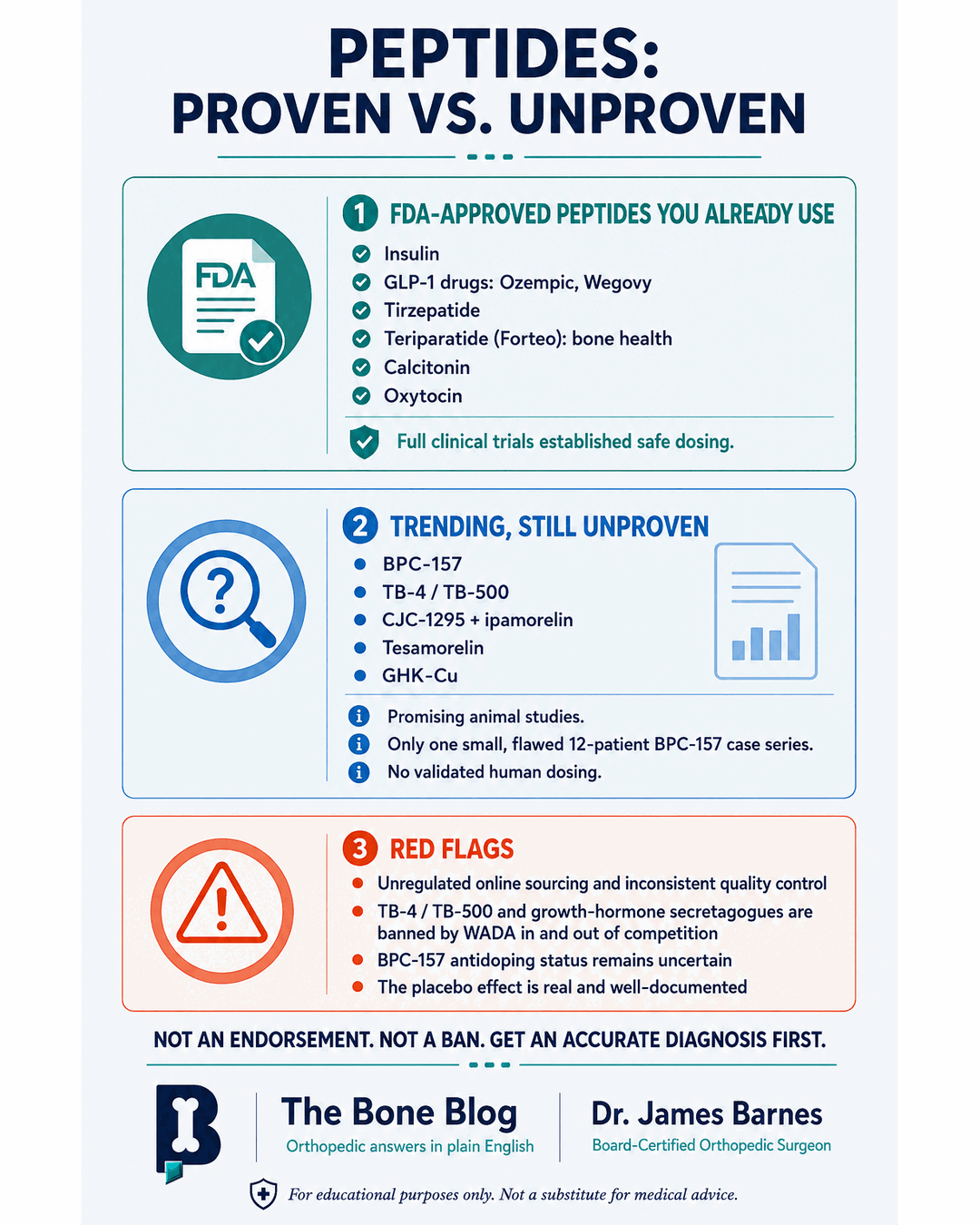
A 2025 systematic review examining BPC-157 for orthopedic applications found 36 eligible studies. Thirty-five were preclinical studies and only one involved patients with a musculoskeletal condition. That small retrospective study included 12 patients treated for chronic knee pain. There were no high-quality randomized trials demonstrating improved tendon healing, ligament healing, fracture healing, or return to sport.
A 2026 orthopedic review reached essentially the same conclusion. There are interesting mechanisms and encouraging laboratory findings involving several peptides, but clinical trials supporting routine orthopedic use remain lacking.
A more recent sports-medicine review similarly concluded that claimed musculoskeletal benefits remain unsubstantiated by current human trials.
That distinction matters. A substance can produce fascinating results in cells or rodents and still fail to meaningfully improve recovery in humans.
What about safety?
This is another area where patients deserve more transparency.
We do not have enough human evidence to confidently define the long-term safety of BPC-157. A tiny pilot study has examined intravenous BPC-157 in only two people. That is nowhere near enough evidence to establish safety.
Product quality adds another issue.
The FDA has raised concerns about BPC-157 involving potential immunogenicity, peptide impurities, and inadequate safety information. BPC-157 is not FDA-approved for treating tendon, ligament, muscle, joint, or bone injuries.
For competitive athletes, there is another consideration. TB-500, thymosin beta-4 derivatives, and several growth-hormone-related peptides are prohibited under WADA rules.
Would I use peptides for an orthopedic injury?
I would not currently consider BPC-157 or TB-500 standard orthopedic treatment.
That does not mean they will never have a role.
Some of the underlying biology is genuinely interesting, and further research is justified. What is not justified is presenting experimental therapy as established regenerative medicine before good human trials demonstrate that it actually improves meaningful outcomes.
For me, the question is not simply, “Could this theoretically stimulate healing?”
It is, “Does it help patients heal better, faster, or more reliably than what we are already doing, and can we demonstrate that safely?”
Right now, we do not have that answer.
What should you do instead?
If an injury is not healing, I would first figure out why.
For a tendon problem, that may mean confirming the diagnosis, evaluating the degree of tendon damage, reviewing training load and rehabilitation, and looking for mechanical factors that continue to irritate the tissue.
For persistent joint pain, the issue might instead be arthritis, cartilage damage, instability, a meniscus or labral injury, or something entirely different.
Depending on the diagnosis, treatment might include activity modification, targeted physical therapy, medications when appropriate, bracing, injections, or occasionally surgery.
The treatment should follow the diagnosis, not the trend.
The bottom line
I am interested in peptides. I am just not ready to pretend the evidence is stronger than it is.
BPC-157 and similar compounds have intriguing laboratory data, but we still need high-quality human trials establishing meaningful orthopedic benefits, appropriate dosing, product quality, and safety.
If you are considering peptide therapy because an injury is not improving, getting the diagnosis right is probably more important than choosing the newest treatment.
References
- BPC-157 in Orthopaedic Sports Medicine: A Systematic Review.
- Therapeutic Peptides in Orthopaedics.
- Peptide Supplements in Sports Medicine.
- Injectable Peptide Therapy Review.
Visual summary
Frequently asked questions
Are peptides steroids?
No. Peptides and anabolic steroids are different classes of compounds, although some peptides can affect hormonal pathways.
Is BPC-157 FDA approved for orthopedic injuries?
No. BPC-157 is not an FDA-approved treatment for tendon, ligament, muscle, joint, or bone injuries.
Does BPC-157 heal tendons faster?
Animal and laboratory research is encouraging, but there are not currently high-quality human trials showing that BPC-157 reliably accelerates tendon healing.
What about TB-500?
TB-500 has preclinical rationale, but human orthopedic evidence is lacking. Competitive athletes should also know that TB-500 is prohibited under WADA rules.
Are compounded peptides safer than peptides bought online?
Compounding and internet sourcing are not equivalent, but compounded does not automatically mean FDA-approved or proven safe and effective for orthopedic use. Product quality, purity, sterility, and regulatory status matter.
Could peptides eventually become legitimate orthopedic treatments?
Yes, they may. The key unanswered question is whether promising mechanisms translate into clinically meaningful benefits with acceptable safety in human trials.
Need a joint checked?
If pain, instability, an injury, or mechanical symptoms are limiting your activity, an orthopedic evaluation can help clarify the cause.
Schedule an Appointment