
A painful twist of the knee, swelling, or a new catching sensation can make people wonder whether they tore a meniscus. That is a reasonable concern—but a suspected meniscus tear does not automatically mean you need an MRI, and it certainly does not automatically mean you need surgery.
If swelling is the main concern, the timing and location of knee swelling can help narrow the cause.
The more useful questions are: What happened? Which symptoms are persistent? What can you no longer do comfortably? And do the history, examination, and imaging point to the meniscus as the actual source of the problem?
What symptoms can suggest a meniscus injury?
Symptoms that raise my suspicion include knee pain, swelling, pain with twisting, or painful mechanical symptoms such as popping, catching, clicking, or locking. An identifiable event also matters. A patient may remember planting the foot, turning, squatting, or changing direction and then developing immediate pain.
The timing helps separate an acute injury from gradual degenerative changes. A distinct event followed by pain fits an acute injury more closely. Osteoarthritis and degenerative meniscal changes more often develop gradually, although the two conditions can overlap.
Not every click or pop is a true locked knee
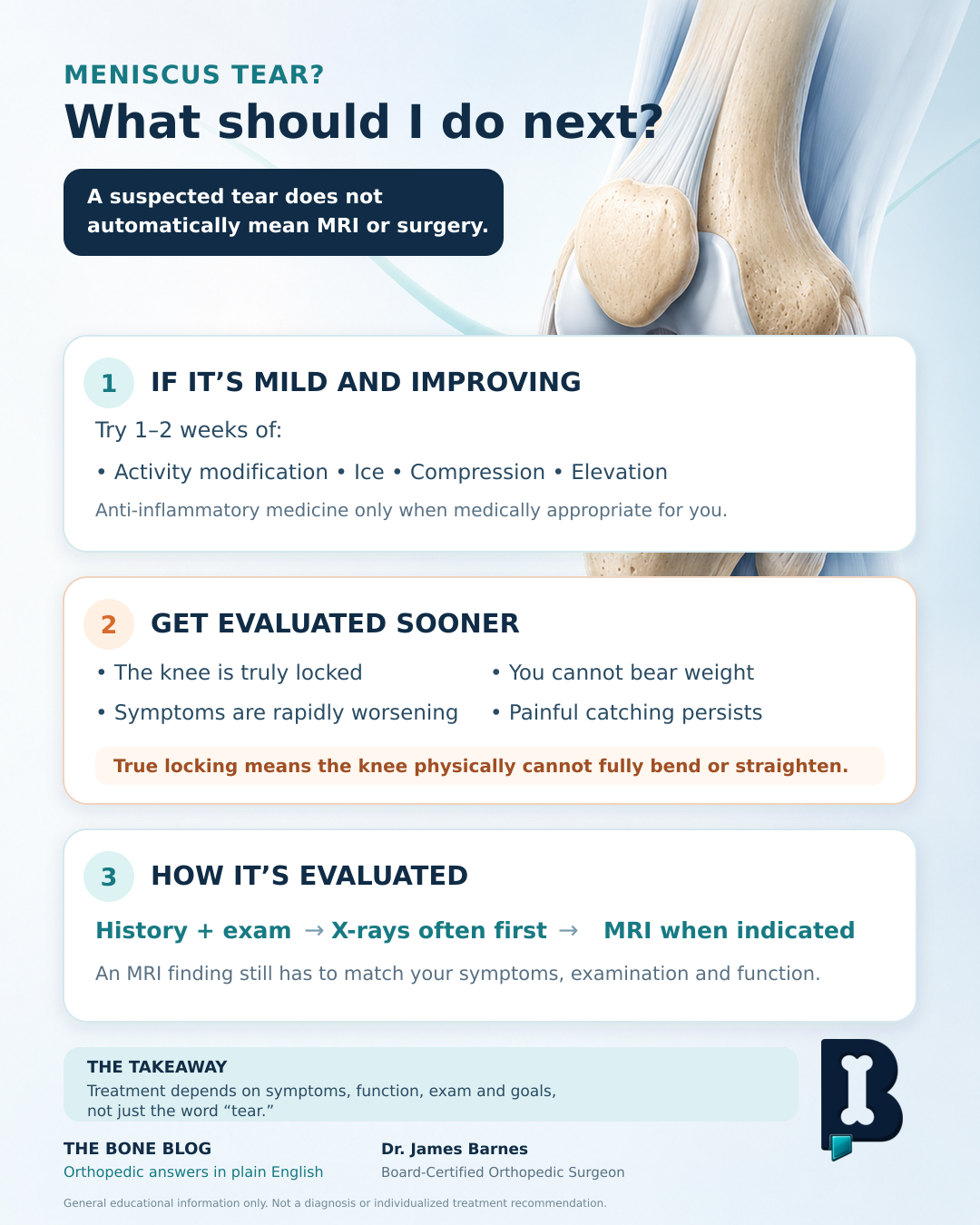
Patients often use the word “locking” to describe several different sensations. True locking means there is a physical mechanical block: despite the patient’s effort—or mine—the knee simply will not fully bend or straighten.
I describe the difference this way: transient popping, catching, or clicking can feel like going over a speed bump. True mechanical locking is more like running into a wall.
A knee that is truly stuck deserves earlier evaluation because displaced tissue or another mechanical problem may be blocking motion.
What should I do first?
When symptoms are mild and improving, it is reasonable to watch them for a short period. Initial measures can include:
- Rest and activity modification
- Ice
- Compression
- Elevation
- Anti-inflammatory medication when it is medically appropriate for you
I generally do not have a problem with a patient trying these measures for one to two weeks. The key is the direction of the symptoms. If the knee is improving, continued observation may be reasonable. If it is not improving after about two weeks, is getting worse, or is producing persistent painful mechanical symptoms, it is time for an evaluation.
Evaluation should happen sooner for a true locked knee, rapidly worsening symptoms, inability to bear weight, or other concerning features.
How is a meniscus tear diagnosed?
There is no single test that makes the diagnosis by itself. I consider all the pieces together.
The history tells me whether there was an injury, how quickly symptoms began, where the pain is located, whether swelling developed, and which movements reproduce the problem.
During the examination, I look for joint-line tenderness and assess whether loading the meniscus reproduces pain. A deep squat, loaded twisting, range of motion, swelling, and ligament stability can all provide useful information.
The history, physical examination, and imaging are parts of the same puzzle. None should be interpreted in isolation.
Do I need an X-ray or MRI?
For a knee injury, X-rays are an appropriate place to start. Multiple views help evaluate the bones, alignment, fractures, and arthritic changes. X-rays do not show the meniscus directly, but they can identify other causes of pain and provide important context.
If the history and examination fit a soft-tissue injury—particularly when painful mechanical symptoms persist—an MRI may be an appropriate next step.
An MRI finding still has to match the patient. Meniscal changes are common, especially as people get older, and some tears coexist with knee osteoarthritis without causing the dominant symptoms. The goal is not simply to find an abnormality on a scan. The goal is to determine whether the imaging finding explains the pain and functional limitation.
Does every meniscus tear require surgery?
No. Conservative treatment is a legitimate option and may include activity modification, ice, compression, anti-inflammatory medication, physical therapy, bracing, or injections, depending on the overall diagnosis.
Surgery can also be discussed, but the decision should be made through shared decision-making. Patients need to understand the available options, what surgery can and cannot accomplish, whether the tear is likely to be the pain generator, and whether surgery is indicated in their particular situation.
The diagnosis alone should not determine the treatment. The patient’s symptoms, function, goals, tear characteristics, arthritis, and response to nonsurgical care all matter.
Meniscus repair versus trimming the torn tissue
When surgery is appropriate, the next question is whether the meniscus can be repaired or whether unstable tissue should be trimmed back to a stable base.
Repairability depends partly on blood supply. Blood reaches the meniscus from the capsular tissue, so the portion closest to the capsule—the red-red zone—has the best healing potential. The shape and pattern of the tear also influence whether a repair is likely to heal.
Whenever a meniscus is realistically repairable, preserving it is important. The meniscus functions as shock-absorbing cartilage and helps maintain the native biomechanics of the knee.
Not every tear can be repaired. In some cases, the most appropriate surgical treatment is a partial meniscectomy or debridement, removing only unstable tissue while preserving as much functional meniscus as possible.
Recovery is different after repair and partial meniscectomy
A meniscus repair requires protection while the tissue heals. Patients are commonly placed in a postoperative knee brace and use protected weight-bearing for approximately six weeks, although the exact protocol depends on the tear and repair. Physical therapy then progresses in stages.
After a simple partial meniscectomy, there is usually much less restriction on weight-bearing or range of motion. Patients often let pain guide their early activity, and a postoperative brace is generally not required.
A repair therefore has a longer and more protective recovery, but it preserves native meniscal tissue when healing is possible.
The most important takeaway
Do not assume that a suspected meniscus tear automatically means surgery—or even that a tear is necessarily causing the symptoms.
Start with the reason you think the meniscus is injured and what the knee problem is preventing you from doing. A careful history, physical examination, and imaging when indicated can identify the best next step and set realistic expectations.
This article provides general educational information and is not a diagnosis or an individualized treatment recommendation.
References
- Englund M, et al. Incidental Meniscal Findings on Knee MRI in Middle-Aged and Elderly Persons. New England Journal of Medicine. 2008.
- Noorduyn JCA, et al. Effect of Physical Therapy vs Arthroscopic Partial Meniscectomy in People With Degenerative Meniscal Tears: Five-Year Follow-up of the ESCAPE Randomized Clinical Trial. JAMA Network Open. 2022.
- van der Graaff SJA, et al. Arthroscopic Partial Meniscectomy Versus Physical Therapy for Traumatic Meniscal Tears in a Young Study Population: A Randomized Controlled Trial. British Journal of Sports Medicine. 2022.
- Migliorini F, et al. Meniscectomy Is Associated With a Higher Rate of Osteoarthritis Compared to Meniscal Repair Following Acute Tears: A Meta-analysis. Knee Surgery, Sports Traumatology, Arthroscopy. 2023.
Visual summary
Frequently asked questions
Can I walk on a suspected meniscus tear?
Many people can walk, but pain, swelling, instability, or a mechanically locked knee may limit weight-bearing. Activity should be modified rather than forced through worsening pain.
How long should I wait before getting it checked?
When symptoms are mild and improving, one to two weeks of conservative care may be reasonable. Persistent symptoms, worsening pain, or true locking warrant evaluation sooner.
Will an X-ray show a meniscus tear?
No. X-rays do not directly show the meniscus, but they are useful for evaluating fractures, alignment, and arthritis and are often the correct first imaging study.
Does an MRI-confirmed tear mean I need surgery?
No. MRI findings must match the symptoms and examination. Many tears can initially be treated without surgery, and some MRI-detected tears may be incidental.
What is the difference between meniscus repair and meniscectomy?
A repair sutures healable tissue and requires a longer protected recovery. A partial meniscectomy trims unstable, nonrepairable tissue and usually allows faster early weight-bearing and motion.
Need a joint checked?
If pain, instability, an injury, or mechanical symptoms are limiting your activity, an orthopedic evaluation can help clarify the cause.
Schedule an Appointment