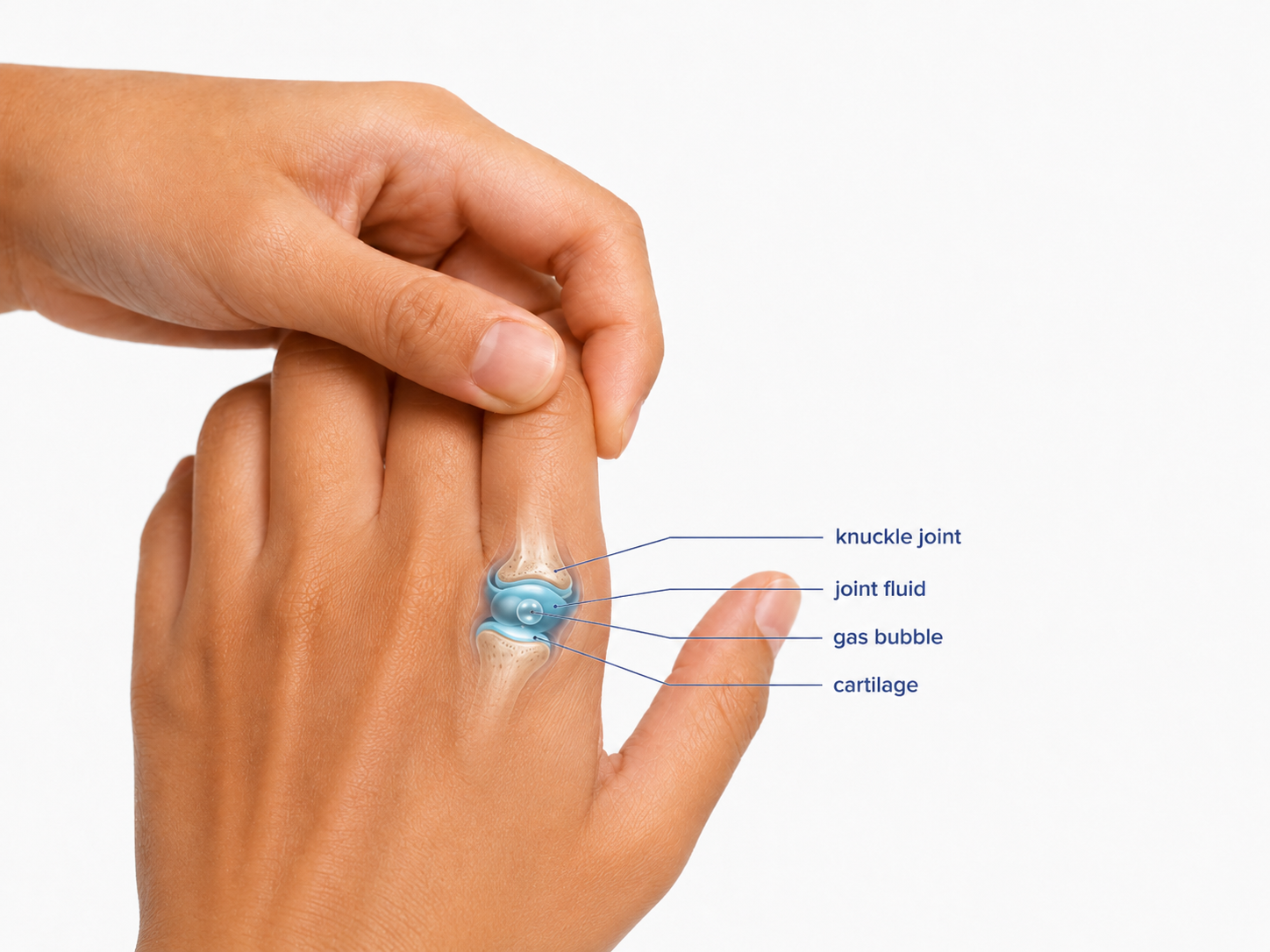
Cracking your knuckles probably will not give you arthritis. That claim has been repeated for decades, but the evidence behind it is thin.
What matters more than the sound is what the joint is doing: is it painful, swollen, stiff, or losing function? Those signals carry far more clinical weight than the pop itself.
Why do knuckles crack?
Finger joints contain cartilage, a joint capsule, and synovial fluid — the lubricant that allows smooth movement. When a joint is stretched or manipulated, the pressure inside changes. The prevailing explanation is cavitation: a gas cavity forms within the synovial fluid, and the formation or collapse of that cavity produces the familiar pop.
This is the same general phenomenon described in larger joints. The sound relates to joint mechanics, not to cartilage wearing away.
Does cracking your knuckles cause arthritis?
The concern that knuckle cracking causes arthritis has been studied, and the evidence against it is reasonably consistent.
A 2011 observational study published in the Journal of the American Board of Family Medicine evaluated hand radiographs and physical examinations in habitual knuckle crackers compared with those who did not crack their knuckles. Researchers found no statistically significant difference in the prevalence of hand osteoarthritis between the two groups.
There is also a well-known self-experiment by Donald Unger, a physician who cracked the knuckles on his left hand daily for roughly 60 years while leaving his right hand alone as a control. He reported no difference in arthritis between the two hands. A single self-reported experiment is not rigorous evidence, but it contributed to the broader picture and earned him an Ig Nobel Prize in 2009.
The data as a whole does not support the arthritis claim. Habitual knuckle cracking is more likely a harmless habit than a medical risk.
Why does it feel satisfying?
Many people describe knuckle cracking as satisfying or relieving. This likely relates to brief changes in joint pressure rather than any structural benefit. The sensation is real — but it does not mean the joint needed to crack.
Are some hand sounds different?
A single cavitation pop is different from persistent grinding, grating, or crackling during normal hand movement. The latter pattern — particularly when associated with pain or stiffness — can reflect rougher joint surfaces and is worth discussing with a physician, especially if it is new or changing.
This article focuses on the typical habitual knuckle crack. The broader question of why joints make noise generally is addressed in “Why Do Joints Pop and Crack?”.
When do hand symptoms deserve evaluation?
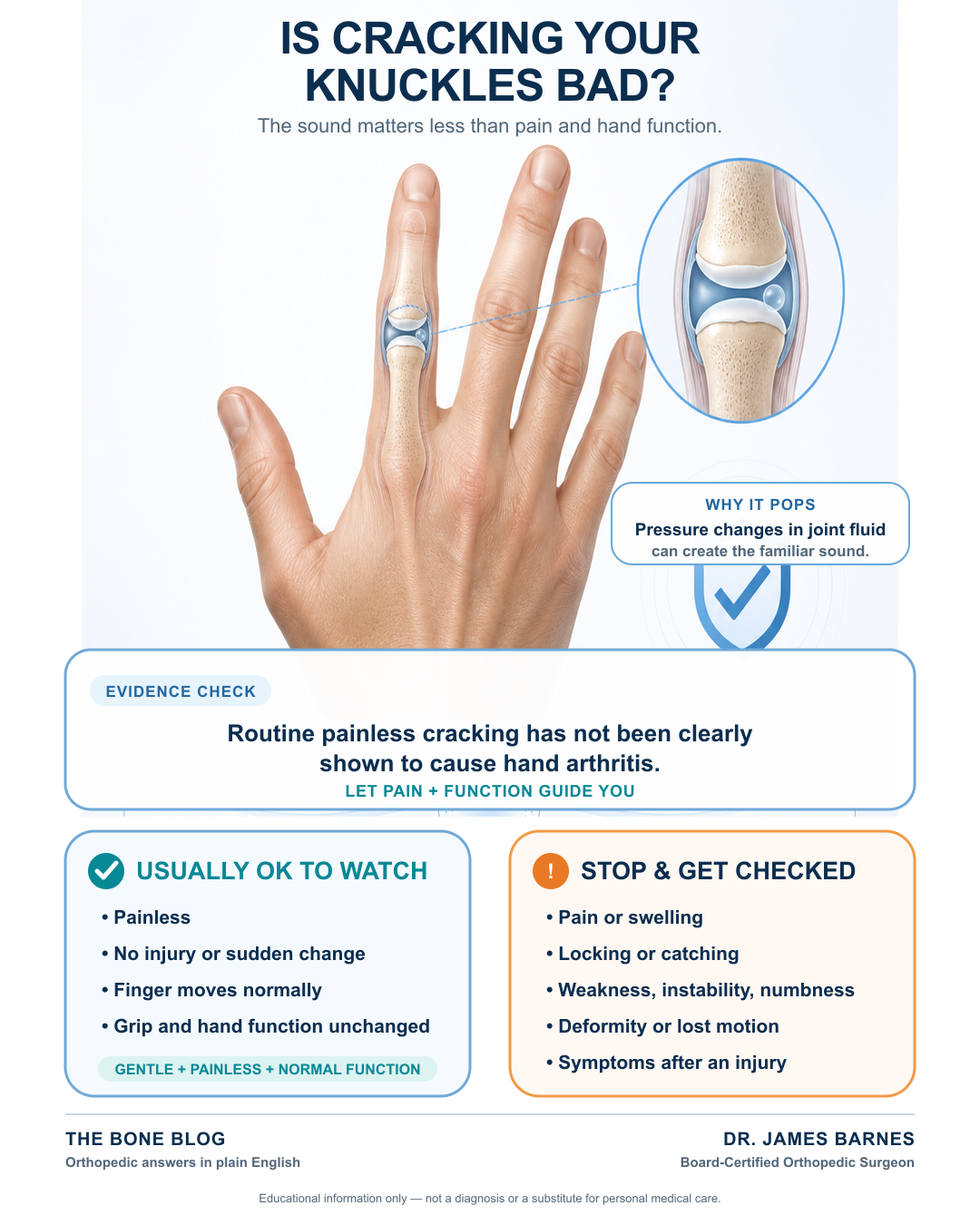
The sound of knuckle cracking alone is rarely a reason to seek care. The following symptoms are different:
- Pain with cracking — if cracking produces or reliably accompanies pain, something beyond a routine joint sound may be present.
- Swelling — persistent or recurrent swelling in a finger joint can indicate inflammation, injury, or early arthritis.
- Morning stiffness lasting more than a few minutes — this pattern is associated with inflammatory arthritis and is worth discussing.
- Reduced grip strength or difficulty with daily tasks — functional loss is a meaningful sign.
- Numbness or tingling — these symptoms can reflect nerve involvement rather than a joint problem.
- Catching, locking, or triggering of a finger — these mechanical symptoms suggest a structural issue such as trigger finger.
- Visible deformity or instability — any new deformity should be evaluated.
- A change after a specific injury — a pop that follows a fall, a forced twist, or direct impact is different from a habitual crack and should be checked.
The cracking itself rarely identifies a problem. The associated symptoms are the more reliable guide.
Bottom line
Cracking your knuckles is almost certainly not giving you arthritis. If the cracking is painless and your hands are functioning normally, watchful waiting is reasonable.
If cracking is accompanied by pain, swelling, stiffness, weakness, or a change in how the finger works — especially after an injury — a hand and wrist evaluation is worthwhile.
References
- deWeber K, Olszewski M, Ortolano R. Knuckle Cracking and Hand Osteoarthritis. Journal of the American Board of Family Medicine. 2011;24(2):169–174.
- Boutin RD, Netto AP, Nakamura D, et al. “Knuckle Cracking”: Can Blinded Observers Detect Changes With Physical Examination and Sonography? Clinical Orthopaedics and Related Research. 2017;475(4):1265–1271.
- Kawchuk GN, Fryer J, Jaremko JL, et al. Real-Time Visualization of Joint Cavitation. PLOS ONE. 2015;10(4):e0119470.
Visual summary
Frequently asked questions
Does cracking your knuckles cause arthritis?
Current evidence does not support a clear link. Studies examining hand radiographs and physical examinations in habitual knuckle crackers versus non-crackers have not found a significant association with hand osteoarthritis. The arthritis concern is a persistent myth rather than an established medical risk.
Is it harmful to crack your knuckles every day?
If the cracking is painless and not associated with any change in grip, motion, or function, there is no strong evidence that the habit causes long-term harm. Pain, swelling, stiffness, or weakness are more clinically meaningful than the habit itself.
Why do knuckles make a popping sound?
The most commonly cited explanation is cavitation — a temporary pressure change in the synovial fluid inside the joint creates a small gas cavity, and the formation or collapse of that cavity produces the pop. The sound is mechanical, not structural damage.
When should hand or knuckle symptoms be evaluated?
Symptoms worth evaluating include pain associated with the cracking, persistent swelling, morning stiffness lasting more than a few minutes, reduced grip strength, numbness or tingling, a finger that catches or locks, visible deformity, instability, or any change that followed a specific injury.
Can knuckle cracking ever cause injury?
The medical literature includes isolated reports of soft tissue injuries from forceful or extreme joint manipulation, but routine habitual cracking is not the same scenario. A pop that follows trauma — a fall, a forced twist, a direct blow — should be evaluated regardless of whether it felt or sounded like a routine crack.
Need a joint checked?
If pain, instability, an injury, or mechanical symptoms are limiting your activity, an orthopedic evaluation can help clarify the cause.
Schedule an Appointment