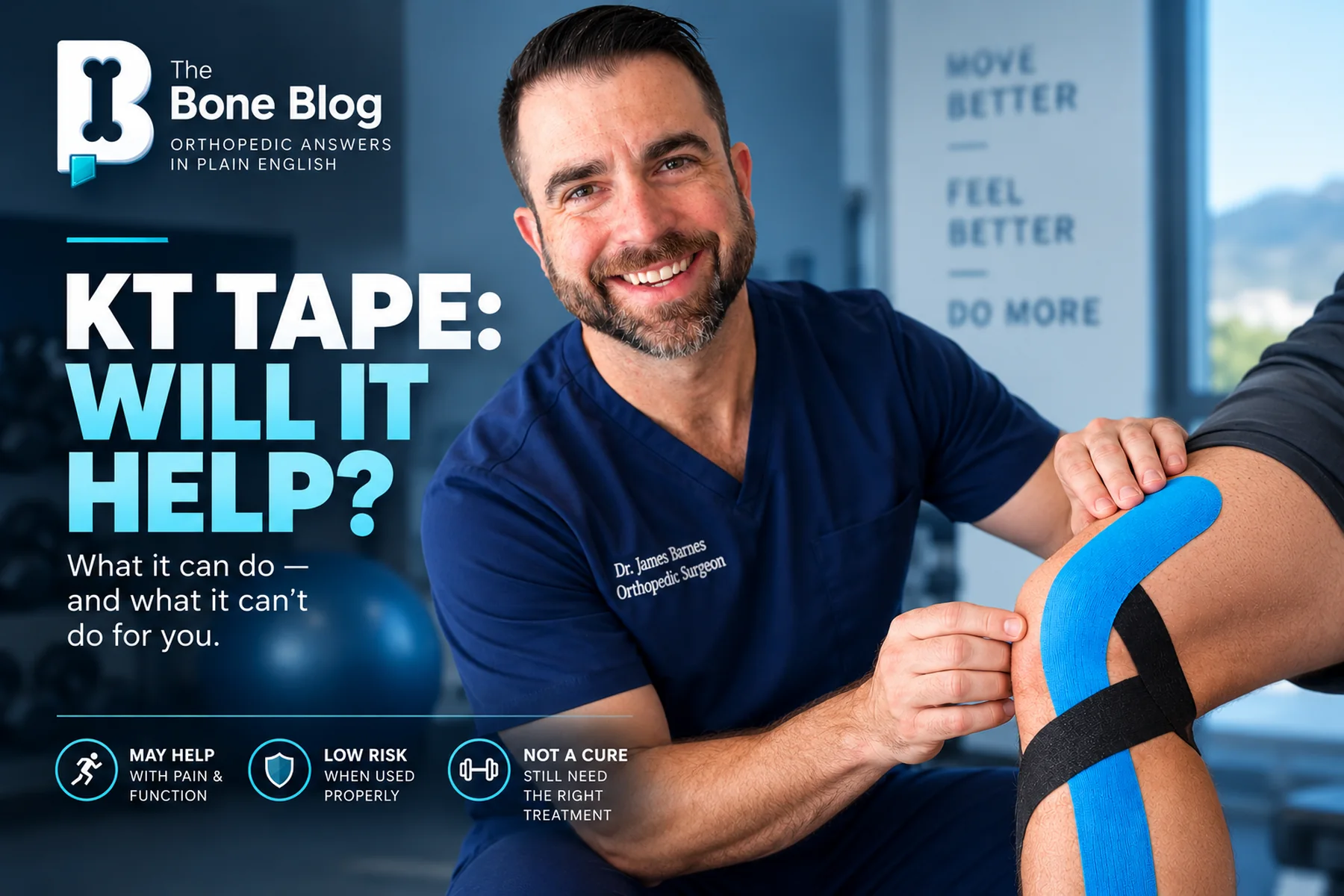
You’ve seen it on professional athletes, runners, and people at the gym: brightly colored strips of tape running across a knee, shoulder, ankle, or elbow. Kinesiology tape, often called KT tape, is everywhere. But does it actually work?
My answer is a little less exciting than the marketing: maybe, but probably not for the reasons you’ve been told.
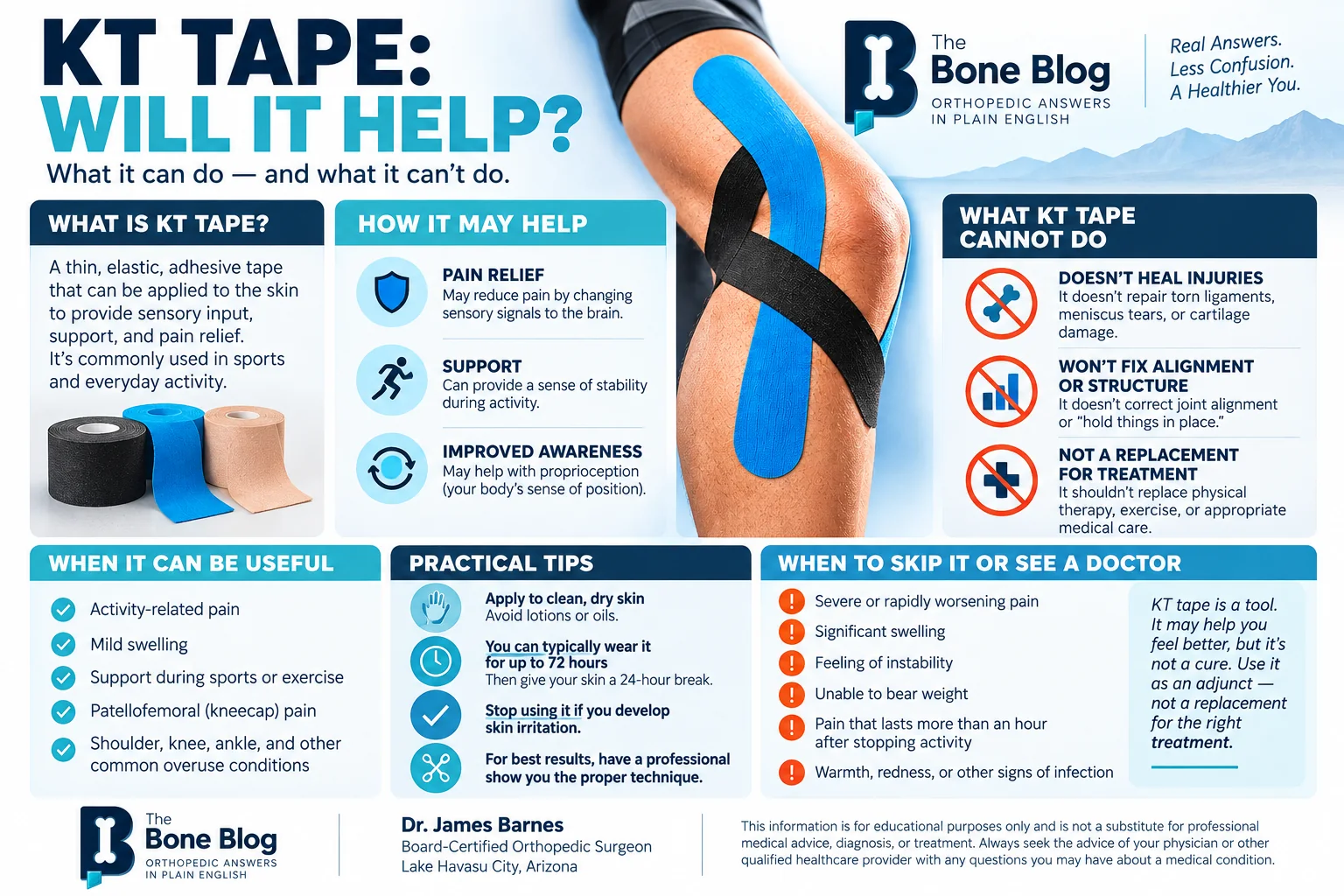
What KT tape may actually do
I’m not a fully convinced believer in kinesiology tape. We don’t have rigorous evidence showing that it reliably fixes musculoskeletal problems across the board. Research suggests that some patients can experience small, short-term improvements in pain, but KT tape generally hasn’t proven superior to active treatments such as exercise or physical therapy.
Where I think it makes the most sense is sensory feedback. Tape on the skin may give your nervous system another reminder about where a joint is and how you’re moving it. That may improve body awareness, or proprioception, and remind an athlete to pay attention to mechanics and positioning.
That’s different from saying the tape is correcting the underlying anatomy.
What KT tape probably isn’t doing
This is where some of the marketing gets ahead of the physiology.
Putting tape on the skin doesn’t repair a torn tendon, restore damaged cartilage, heal a ligament, or correct most structural abnormalities. Claims that a particular taping pattern can completely restore function or induce tissue healing deserve skepticism unless there’s good evidence behind them.
There may also be an expectancy or placebo component. That doesn’t mean someone’s improvement is imaginary. Feeling supported can change confidence, movement, and pain perception. If an athlete tells me, “I feel better when I’m taped,” I don’t need to talk them out of something that’s inexpensive and relatively low risk.
Where can you try it?
The shoulder, elbow, knee, and ankle are common places to see kinesiology tape. I’m comfortable with patients trying it around these joints if it makes activity more comfortable.
The key word is adjunct.
KT tape shouldn’t be the entire treatment plan for an injury. Depending on the problem, appropriate conservative care may include physical therapy, progressive strengthening, activity modification, anti-inflammatory medication when appropriate, bracing, ice or other symptom-control measures, and a good warm-up and cool-down.
Tape can be one piece of that plan. It shouldn’t replace the pieces that address the actual problem.
A practical way to decide whether it’s worth it
KT tape is relatively inexpensive. Try it. If you move better, hurt less, or simply feel more confident with it on, there’s nothing wrong with continuing to use it as part of a broader treatment strategy.
If it doesn’t help, stop buying it. You haven’t invested hundreds of dollars in an unproven treatment.
I generally wouldn’t leave the same application on indefinitely. As a practical rule, I’d remove it by about 72 hours, inspect and rest the skin, and consider reapplication later if there’s no irritation. That’s practical clinical guidance rather than a universal evidence-based wear-time rule. Remove it sooner for itching, burning, blistering, or significant redness.
And remember that feeling better with tape doesn’t mean an injury has healed.
One rule I often give patients about activity is this: if something still hurts more than an hour after you stop the activity, you probably overdid it and should back off. That’s a practical load-management rule of thumb, not a diagnostic test.
The bottom line
KT tape is not magic, and I don’t think the science supports many of the bigger claims made about it. It may provide sensory feedback, a feeling of support, and modest short-term symptom relief for some people.
The downside is generally small. So if it helps you feel better, I’m fine with you using it.
Just don’t mistake support for healing. Use the tape if you like it, but keep working on the strength, mechanics, mobility, and underlying diagnosis that actually matter.
References
- Parreira P do C S, et al. Current evidence does not support the use of Kinesio Taping in clinical practice: a systematic review. Journal of Physiotherapy. 2014.
- Lim ECW, Tay MGX. Kinesio taping in musculoskeletal pain and disability that lasts for more than 4 weeks: a systematic review with meta-analysis. British Journal of Sports Medicine. 2015.
- Gianola S, et al. Kinesio taping for rotator cuff disease. Cochrane Database of Systematic Reviews. 2021.
- Atwater AR, et al. Medical adhesive allergens: Retrospective analysis of cross-sectional data from the North American Contact Dermatitis Group, 2001-2018. Journal of the American Academy of Dermatology. 2022.
Visual summary
Frequently asked questions
Does KT tape actually work?
It may help some people with short-term pain, sensory feedback, or a feeling of support. Evidence is inconsistent, and benefits are generally modest. It has not been shown to reliably correct the underlying cause of an orthopedic injury.
Does KT tape heal injuries?
There is not good evidence that taping the skin heals torn tendons, damaged cartilage, ligament injuries, or other structural problems. It should be viewed as an adjunct rather than a biological healing treatment.
Is KT tape just placebo?
Not necessarily. Cutaneous sensory input and proprioceptive effects are biologically plausible, and some studies show small benefits. Expectancy and the psychological feeling of support may also contribute.
Can I exercise with KT tape?
Usually, yes, if the activity itself is appropriate for your injury. Feeling better with tape should not be interpreted as proof that the underlying injury is healed.
How long should I leave KT tape on?
Dr. Barnes generally recommends removing an application by about 72 hours as a practical skin-care rule and giving the skin a break before reapplication. Manufacturer instructions vary. Remove it earlier if you develop irritation, itching, burning, blistering, or significant redness.
Should I use KT tape instead of physical therapy?
No. When rehabilitation is indicated, exercise and physical therapy address strength, mobility, mechanics, and progressive loading in ways tape cannot.
Need a joint checked?
If pain, instability, an injury, or mechanical symptoms are limiting your activity, an orthopedic evaluation can help clarify the cause.
Schedule an Appointment