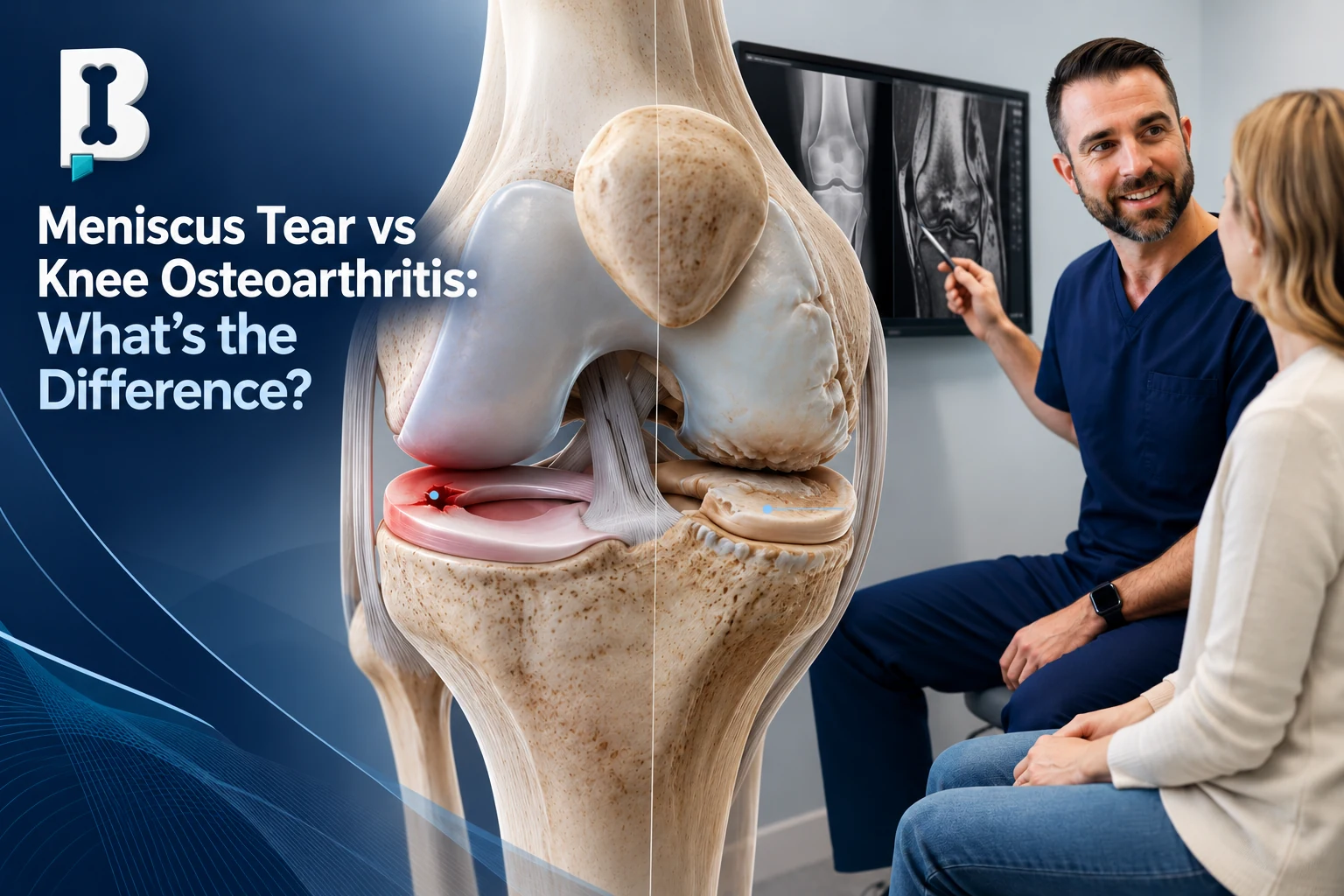
A meniscus tear and knee osteoarthritis can cause pain in the same part of the knee. They can also exist at the same time, especially as we get older. That overlap is why the answer usually cannot be found from one symptom or one line in an MRI report.
The goal is to understand the complete clinical picture: how the pain started, where it hurts, what movements provoke it, whether the knee has painful mechanical symptoms, what the physical examination shows, and whether the imaging findings match the patient’s story.
The most important principle is simple: treat the patient, not the MRI.
What is the meniscus?
The meniscus is the shock-absorbing cartilage between the thighbone and shinbone. Each knee has a medial meniscus on the inner side and a lateral meniscus on the outer side. A meniscus can tear after a twisting injury, but it can also develop degenerative tearing over time as the knee ages.
A tear on MRI does not always mean the tear is causing pain. Many people have degenerative meniscal changes without realizing it.
What is knee osteoarthritis?
Knee osteoarthritis is the gradual loss and deterioration of the smooth articular cartilage covering the joint surfaces. As that cartilage becomes thinner, the knee may become painful, stiff, swollen, or less mobile.
Arthritis commonly causes activity-related pain, stiffness after sitting, and what I call startup pain: discomfort when first getting up and moving after being still. The knee may also have crepitus, reduced motion, or recurrent swelling.
How did the pain begin?
The onset of symptoms is one of the first clues.
A traumatic meniscus tear is more likely when pain begins suddenly after a specific twisting, pivoting, or squatting event. The patient may remember exactly when it happened.
Arthritis usually develops more gradually. Symptoms may worsen over months or years, fluctuate with activity, and become more noticeable after prolonged sitting or at the beginning of movement.
Degenerative meniscus tears are less straightforward. They may appear without a clear injury and frequently coexist with arthritis. In that situation, the challenge is determining whether the tear is actually generating the symptoms.
Do popping, clicking, catching, or locking mean a torn meniscus?
Not necessarily.
Many knees pop or click without pain. I can usually make each of my own knees pop once during an office encounter, and it does not hurt. Painless, occasional noises are often not a sign of a problem that needs treatment.
Painful mechanical symptoms deserve more attention. Reproducible popping, catching, locking, or clicking—especially when it occurs in a consistent location—may suggest that tissue is physically interfering with motion. Possible causes include a displaced meniscus tear, damaged articular cartilage, or a loose body moving inside the joint.
A true mechanical block is different from a knee that simply feels stiff or painful. A displaced bucket-handle meniscus tear may physically prevent the knee from fully bending or straightening. Loose bodies can sometimes do the same. The history, examination, swelling, range of motion, and imaging should all support that conclusion.
Where does it hurt?
Pain location can help, but it is not definitive.
Meniscus-related pain is often felt along the medial or lateral joint line. Arthritis can also produce joint-line pain, particularly in the same compartment where degenerative meniscal tears are common. The posterior horn of the medial meniscus is a frequent location for tearing, and medial compartment arthritis often affects that same area.
That overlap creates what I call the crystal-ball question: how much of the pain is coming from the meniscus, and how much is coming from the arthritis?
If the symptoms are 90% meniscus and 10% arthritis, treating the meniscus may provide meaningful improvement. If the symptoms are 10% meniscus and 90% arthritis, trimming the torn meniscus may do very little for the patient’s overall pain.
Sometimes that balance cannot be known with complete certainty before surgery. That is why setting expectations is so important.
What does the physical examination add?
The examination is another piece of the puzzle. I look at the location of tenderness, swelling, range of motion, stability, and how the knee responds to provocative maneuvers.
A meniscus tear becomes more clinically convincing when the patient’s pain location, mechanical symptoms, examination findings, and imaging all point to the same structure.
Arthritis becomes more likely when the pattern includes gradual activity-related pain, startup stiffness, crepitus, restricted motion, bony enlargement, or symptoms that correlate with arthritic changes on weight-bearing X-rays.
No single test should be interpreted in isolation.
Do I need an MRI?
Not every patient with knee pain needs an MRI.
Weight-bearing X-rays are often the most useful first imaging study when arthritis is suspected because they show joint-space loss, osteophytes, alignment, and other degenerative changes.
MRI may be appropriate when the history and examination suggest a clinically important meniscus tear, when painful mechanical symptoms persist, when the diagnosis remains uncertain, or when the result is likely to change treatment.
The reason for ordering the MRI matters. If the MRI identifies a tear that matches the patient’s symptoms and examination, the finding may be meaningful. If the report describes a tear that does not correlate with the pain pattern or exam, it may be incidental.
Again: treat the patient, not the MRI.
What treatments are available?
I like to give patients the full menu of reasonable options and let them participate in the decision.
Depending on the patient’s diagnosis, health, prior treatments, goals, and preferences, options may include:
- Activity modification
- Topical or oral anti-inflammatory medication, when medically appropriate
- Bracing
- Physical therapy and strengthening
- Cortisone injection
- Viscosupplementation
- Platelet-rich plasma in selected candidates
- Knee arthroscopy with partial meniscectomy or meniscal repair in appropriate cases
- Partial or total knee replacement when arthritis is advanced and symptoms justify it
The best plan is customized. Imaging alone does not choose the treatment.
When is arthroscopy more likely to help?
I become more inclined toward arthroscopy when several factors align:
- There was an identifiable injury or convincing onset
- The patient has painful, reproducible mechanical symptoms
- The pain location and examination support meniscal pathology
- MRI findings clearly correlate with the story and exam
- Appropriate nonoperative treatment has not provided enough relief
- The patient understands the expected benefit and the limitations of surgery
The presence of a tear by itself is not an indication for surgery.
What can arthroscopy do—and what can’t it do?
Arthroscopy may treat unstable or damaged meniscal tissue that is causing painful mechanical symptoms. If a torn flap is no longer functional, it may be trimmed back to stable tissue. In selected tear patterns, repair may be possible so that more meniscal tissue can be preserved.
But arthroscopy does not reverse arthritis.
I often explain it using a tire analogy. If a flap of tread is loose, you may be able to trim the flap. But you cannot add the lost tread back to the tire. In the same way, arthroscopy can address certain torn or unstable tissue, but it cannot restore the thickness of articular cartilage already lost to osteoarthritis.
During arthroscopy, I take photographs that can show patients the amount of wear inside the knee. Those images may explain why some pain remains even after the meniscus has been treated.
A knee scope cannot roll back the hands of time on an arthritic knee.
When should I seek an orthopedic evaluation?
An evaluation is reasonable when knee pain persists, limits activity, follows a twisting injury, or is associated with swelling, painful catching, repeated giving way, or loss of motion.
More urgent assessment is appropriate when the knee is truly locked, the patient cannot bear weight after an injury, the joint is hot and markedly swollen, there is major deformity, or there are other concerning symptoms.
The bottom line
Meniscus tears and knee osteoarthritis are both common, and neither one is automatically painful. A person may have arthritis without symptoms, a meniscus tear without symptoms, or both findings while only one is responsible for most of the pain.
The right diagnosis comes from gathering the whole picture: the history, examination, imaging, treatment response, surgical indications, and the limitations of what each treatment can accomplish.
This article provides general orthopedic education and is not a diagnosis or individualized medical recommendation. Treatment decisions should be based on an examination by a qualified healthcare professional who can review your symptoms, health history, and imaging.
References
- Duong V, et al. Evaluation and Treatment of Knee Pain: A Review. JAMA. 2023.
- Englund M, et al. Incidental Meniscal Findings on Knee MRI in Middle-Aged and Elderly Persons. New England Journal of Medicine. 2008.
- Noorduyn JCA, et al. Effect of Physical Therapy vs Arthroscopic Partial Meniscectomy in People With Degenerative Meniscal Tears: Five-Year Follow-up of the ESCAPE Randomized Clinical Trial. JAMA Network Open. 2022.
- Lee SH, et al. Revisiting Arthroscopic Partial Meniscectomy for Degenerative Tears in Knees With Mild or No Osteoarthritis: A Systematic Review and Meta-analysis of Randomized Controlled Trials. Clinical Journal of Sport Medicine. 2020.
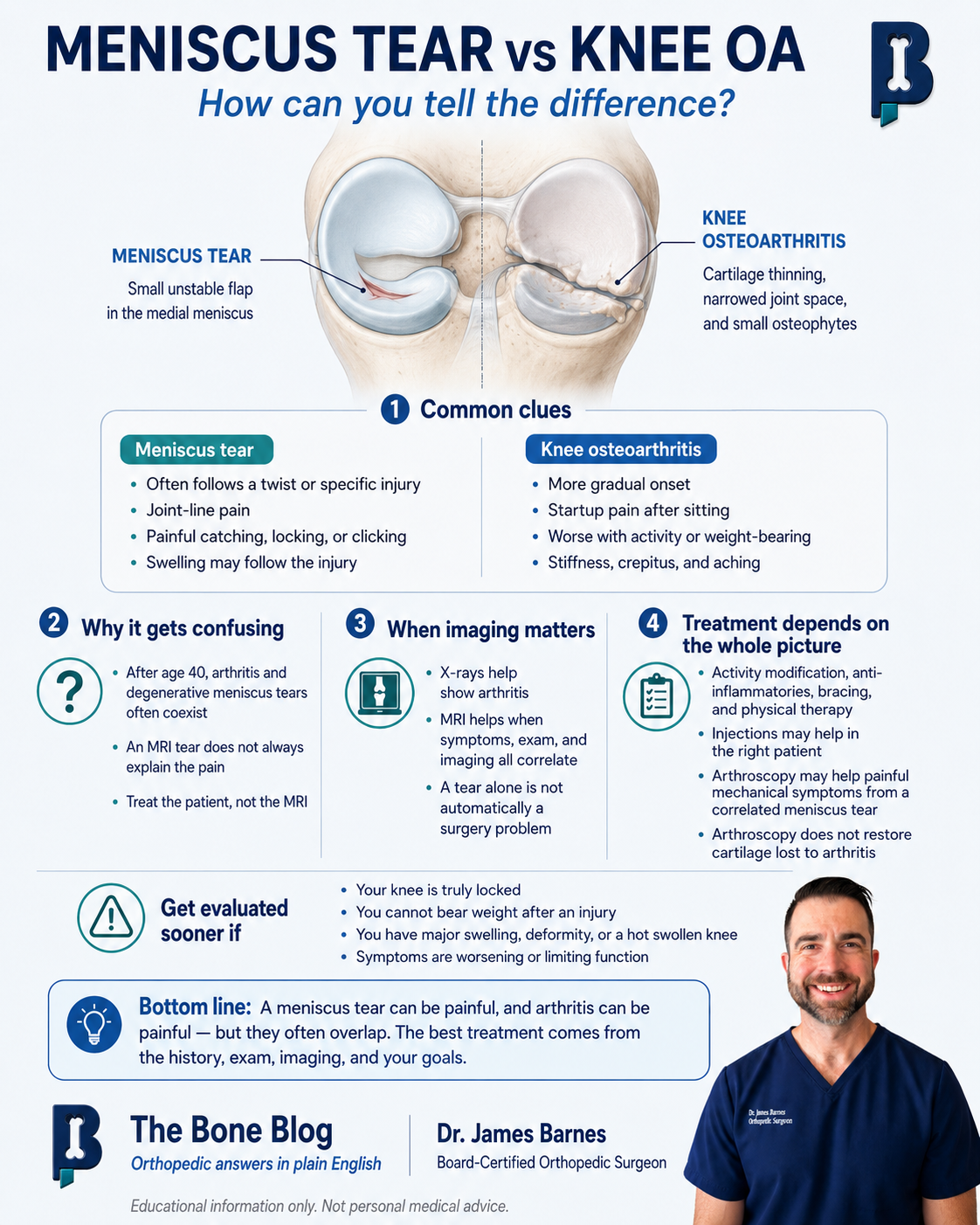
Visual summary
Frequently asked questions
Can knee arthritis feel like a meniscus tear?
Yes. Both can cause joint-line pain, swelling, stiffness, and activity-related symptoms. They also commonly occur together, particularly in adults over 40.
Does a meniscus tear on MRI always need surgery?
No. A meniscus tear may be incidental or degenerative. Surgery is considered when the tear clearly matches the patient's symptoms and examination, especially when painful mechanical symptoms persist despite appropriate conservative treatment.
Does clicking mean I have a torn meniscus?
No. Painless clicking and popping are common. Painful, reproducible catching, locking, or clicking in a consistent location is more concerning for a mechanical problem.
Can arthroscopy fix knee arthritis?
No. Arthroscopy can treat selected meniscal or loose-body problems, but it cannot replace articular cartilage lost to arthritis.
Should I get an MRI or an X-ray first?
When arthritis is suspected, weight-bearing X-rays are often the most useful first study. MRI may be added when the examination suggests a meniscus tear or another soft-tissue problem and the result would affect treatment.
Need a joint checked?
If pain, instability, an injury, or mechanical symptoms are limiting your activity, an orthopedic evaluation can help clarify the cause.
Schedule an Appointment