
Joints can pop, click, crack, snap, grind, or creak for several reasons. The sound alone usually matters less than what comes with it.
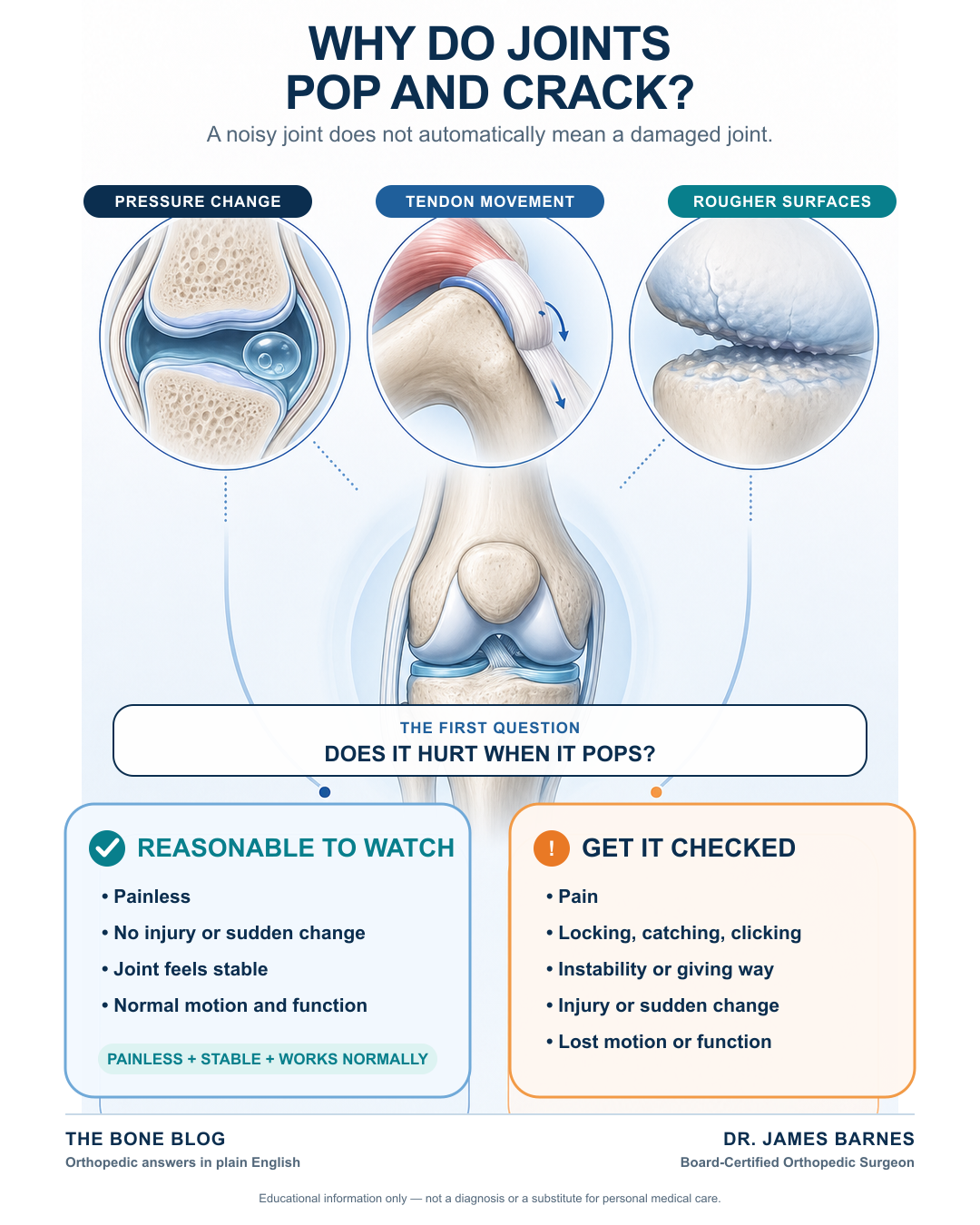
The first question I ask a patient is simple: Does it hurt when it pops? If the sound is painless, stable, and not changing how the joint works, it may only need reassurance. If it is painful, unstable, new after an injury, or associated with locking or catching, it deserves a closer look.
Why can a joint make a popping sound?
One common explanation is a pressure change inside the joint. When joint surfaces separate, dissolved gases in the joint fluid can form a small cavity and create a pop. Real-time MRI research has shown that the sound coincides with the cavity forming, rather than a pre-existing bubble collapsing.
Not every sound comes from that same process. Tendons can move or snap over nearby structures. Rougher joint surfaces can create grinding or creaking. A patient may use the word “pop” for several different sensations, so the history and examination matter more than the word itself.
Is painless popping bad for the joint?
Painless joint noise is common. Many people notice it in their fingers, toes, back, neck, or knees without pain or loss of function.
Both of my knees have popped since I was a teenager. Because the popping is painless and has not limited me, it does not bother me. Sometimes I can reproduce that sound in the exam room, which helps reassure patients that a loud joint is not automatically a damaged joint.
The same principle applies to knuckle cracking. Observational studies have not found an association between habitual knuckle cracking and hand osteoarthritis.
Popping and crepitus are not always the same
A single cavitation-type pop is different from persistent grinding or crackling during movement, often called crepitus. Knee crepitus can occur without pain, but research has associated frequent subjective crepitus with a higher chance of developing symptomatic knee osteoarthritis, particularly among people who already had radiographic changes.
That does not mean crepitus alone diagnoses arthritis. It means the character and pattern of the sound—and the rest of the clinical picture—matter.
Are some joints more concerning than others?
Hands, feet, knuckles, and toes are common places for people to notice routine popping. Many people also deliberately pop their back or neck.
Popping in the shoulder or hip is not always described as routine in the same way, but location alone does not determine whether something is wrong. The key question remains whether the sound is painful, unstable, associated with an injury, or changing function.
When should a popping joint be evaluated?
Watchful waiting is often reasonable when:
- There was no identifiable injury.
- The sound is painless.
- There has not been a sudden change.
- The joint feels stable.
- Motion and normal function are unchanged.
An evaluation makes more sense when the sound comes with:
- Pain.
- Instability or a feeling that the joint may give way.
- Locking, catching, or repeated mechanical clicking.
- A specific injury or sudden change.
- Loss of normal motion or function.
- Inability to use the joint the way you could before.
A pop does not automatically mean you have to stop an activity. A painful feeling with the pop is a reason to stop and get it checked.
What problems can hide behind “my joint keeps popping”?
Sometimes the sound is not the main problem. For example, a patient with shoulder instability may describe a popping sensation but also feel apprehension when the shoulder’s stability is tested. Further imaging may show an injury such as a torn labrum.
Popping and grinding in a knee can also occur when loose pieces of bone or cartilage are moving inside the joint. I remember a patient whose MRI demonstrated several loose bodies. Removing them arthroscopically improved her symptoms.
These examples are not reasons to assume that every noisy shoulder or knee needs surgery. They show why pain, instability, mechanical symptoms, and examination findings matter.
Will I need an X-ray or MRI?
Imaging should follow the history and examination rather than the sound alone. When a patient has already had an X-ray and it is normal, painless popping without concerning examination findings usually does not require more imaging.
Additional X-ray views or an MRI may be appropriate when the initial imaging is abnormal, the examination reproduces pain, instability is suspected, or another pathologic process is possible.
The goal is not to order an MRI for every noisy joint. It is to investigate when the symptoms and examination provide a reason.
What should you do now?
Listen to your body. You know what is normal for you.
If a joint has always popped, remains painless, feels stable, and works normally, watching it is reasonable. If the sound becomes painful, follows an injury, comes with locking or catching, feels unstable, or changes what you can do, schedule an orthopedic evaluation.
Bottom line
A noisy joint does not automatically mean a damaged joint. A stable, painless sound may only need reassurance. Pain, instability, a new injury, mechanical symptoms, or loss of function changes the equation.
Let pain be your guide.
References
- Kawchuk GN, Fryer J, Jaremko JL, et al. Real-Time Visualization of Joint Cavitation. PLOS ONE. 2015;10(4):e0119470.
- deWeber K, Olszewski M, Ortolano R. Knuckle Cracking and Hand Osteoarthritis. Journal of the American Board of Family Medicine. 2011;24(2):169-174.
- Boutin RD, Netto AP, Nakamura D, et al. “Knuckle Cracking”: Can Blinded Observers Detect Changes With Physical Examination and Sonography?. Clinical Orthopaedics and Related Research. 2017;475(4):1265-1271.
- Lo GH, Strayhorn MT, Driban JB, et al. Subjective Crepitus as a Risk Factor for Incident Symptomatic Knee Osteoarthritis. Arthritis Care & Research. 2018;70(1):53-60.
Visual summary
Frequently asked questions
Does joint popping mean cartilage damage?
Not necessarily. Joint sounds can come from pressure changes in joint fluid, tendon movement, or rougher surfaces. Pain, instability, injury, and loss of function are more useful signals than the sound alone.
Is painless joint popping normal?
It is common and is often reasonable to observe when it is stable, painless, and not changing how the joint functions. Persistent grinding or crepitus is a different type of sound and should be considered in context.
When should I stop an activity because of a pop?
A sound alone does not always require stopping. Stop when the pop is painful or when the joint feels unstable or no longer functions normally.
Do I need an MRI for a popping joint?
Not automatically. Imaging depends on the history, examination, and any initial X-rays. MRI is more useful when pain, instability, abnormal findings, or another suspected injury justify it.
What symptoms should prompt an appointment?
Pain, instability, locking, catching, symptoms after an injury, a sudden change, or loss of normal motion or function should be evaluated.
Need a joint checked?
If pain, instability, an injury, or mechanical symptoms are limiting your activity, an orthopedic evaluation can help clarify the cause.
Schedule an Appointment