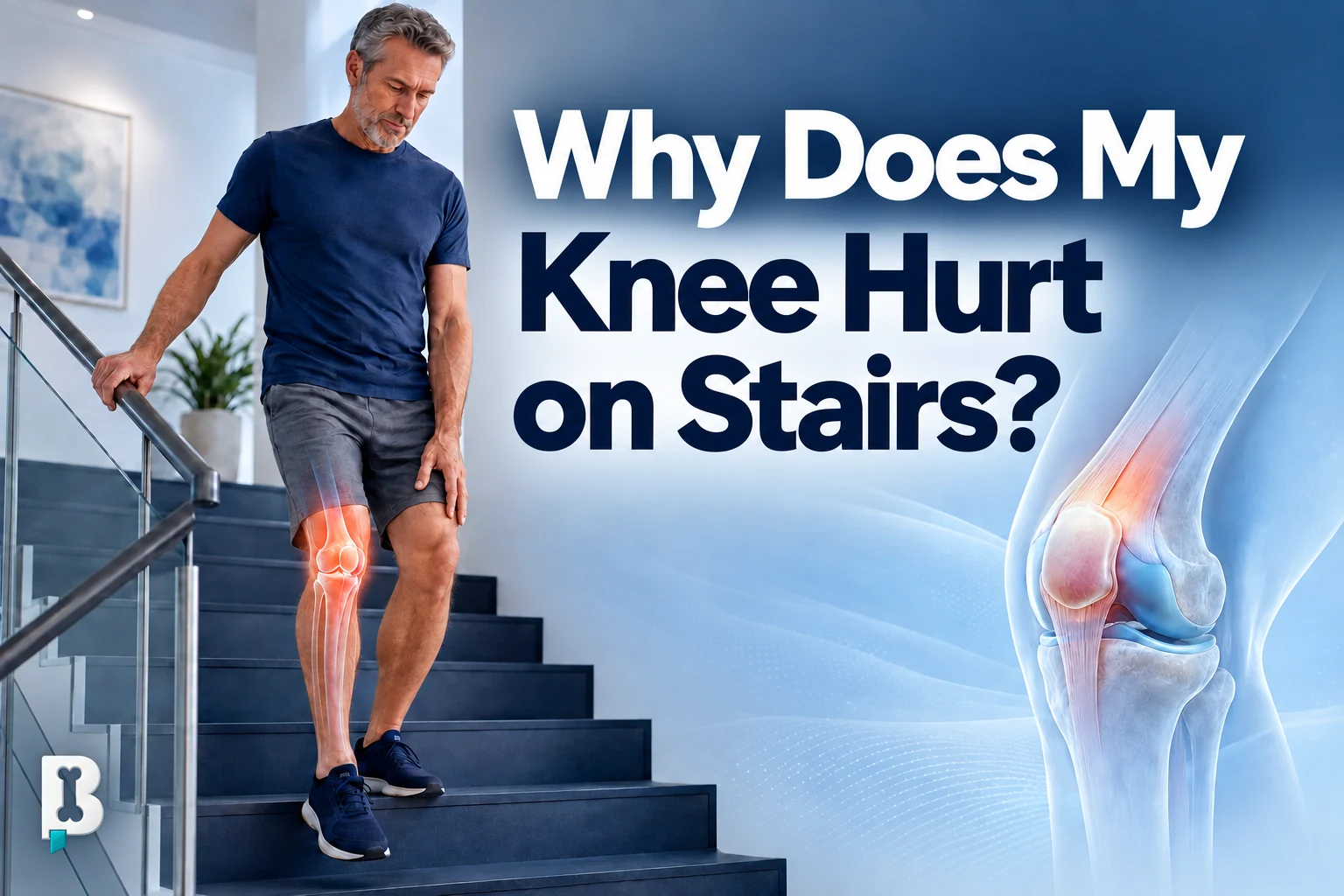
Knee pain on stairs commonly comes from the kneecap joint, an irritated tendon, arthritis, or occasionally a meniscus problem. One of the most useful clues is exactly where the pain occurs and whether it is worse going up or coming down.
Stairs place more demand on a bent knee than level walking. That added load can reveal a problem that may not be noticeable during ordinary daily activity.
Start by pointing to the pain with one finger
When I evaluate this complaint, one of the first things I ask is: “Using one finger, point to where it hurts the most.”
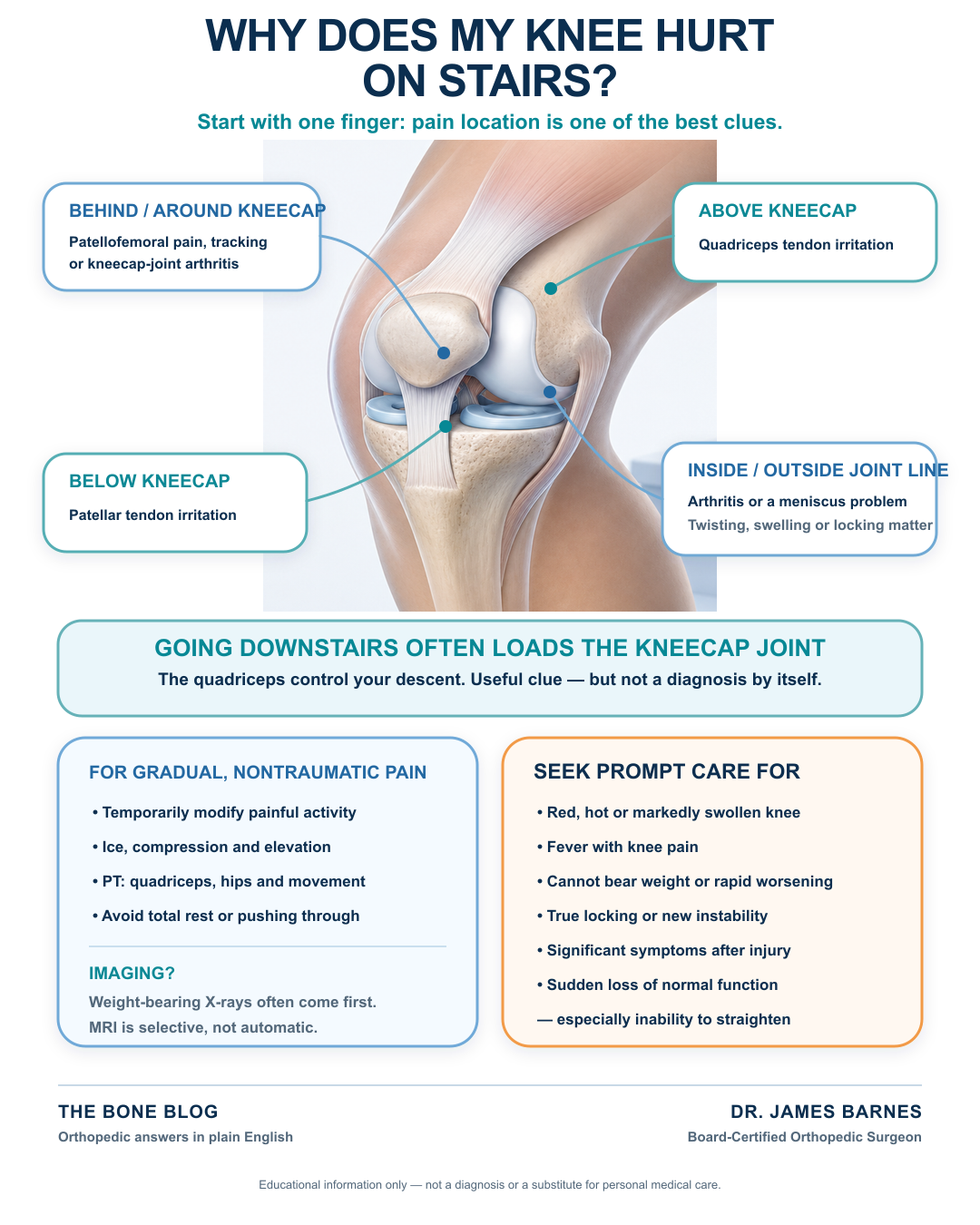
Patients can often localize the pain surprisingly well. Pain behind or around the kneecap suggests a different problem than pain directly above the kneecap, below it, or along the inside or outside joint line. That location does not establish a diagnosis by itself, but it helps narrow the possibilities.
Pain behind or around the kneecap
Pain around or behind the kneecap is commonly associated with the patellofemoral joint, where the kneecap glides within a groove at the end of the thigh bone.
In younger or more active patients, symptoms may be related to patellofemoral pain syndrome. This often involves how the kneecap tracks, how the quadriceps muscles activate, and how the entire leg moves during activity.
Pain may be especially noticeable during stair descent, squatting, lunging, rising from a low chair, or sitting with the knee bent for a long time.
In the office, I watch how the kneecap tracks while the patient actively bends and straightens the knee. A pronounced J sign, where the kneecap shifts abruptly as the knee approaches full extension, may indicate a tracking problem.
Patellofemoral arthritis can cause similar pain, but the underlying issue is different. Rather than primarily being a tracking or muscle-control problem, arthritis involves wear of the cartilage behind the kneecap. I sometimes compare this to inspecting the tread on a tire. The cartilage behind the patella is very thick, but as it wears down, patients may develop pain, stiffness, grinding, or mechanical crepitus.
Pain from patellofemoral arthritis may be more noticeable with deeper knee flexion. Age, activity level, examination findings, and properly selected knee X-rays all help distinguish arthritis from patellofemoral pain without significant cartilage loss.
Pain above or below the kneecap
Pain located directly above or below the kneecap may come from a tendon.
The quadriceps tendon attaches to the top of the kneecap, so tenderness above the patella can suggest quadriceps tendinitis or tendinopathy.
The patellar tendon begins at the lower portion of the kneecap, so pain at or just below the patella may suggest patellar tendinopathy. This tends to be more focal than the broader discomfort patients often describe with patellofemoral pain.
Pain along the inside or outside of the knee
Pain along the medial or lateral joint line may suggest arthritis or a meniscus problem.
A meniscus can become painful when it is compressed and rotated. During an examination, I may reproduce that type of loading by having the patient perform a controlled twist with the knees slightly bent or by rotating the lower leg while applying pressure across the joint.
A history of twisting, swelling, catching, locking, or pain directly along the joint line makes a meniscus problem more concerning.
Do you need an MRI?
Most gradual knee pain on stairs does not require an immediate MRI, especially when there was no injury, instability, or mechanical symptom.
When appropriate, initial treatment may include temporary activity modification, ice, compression, elevation, physical therapy, and anti-inflammatory medication when medically appropriate.
When imaging is needed, weight-bearing knee X-rays are often the starting point. They can show alignment, joint-space narrowing, arthritis, and some bony abnormalities.
An MRI becomes more useful when there has been a clear injury, a major change in function, instability, significant swelling, or new locking, catching, or other mechanical symptoms.
What should physical therapy address?
For patellofemoral pain, therapy should evaluate more than the kneecap alone.
Treatment may focus on quadriceps control, including the vastus medialis portion of the quadriceps, as well as hip strength, gait mechanics, foot and ankle motion, and movement of the entire lower extremity.
The goal is to improve how the kneecap tracks and how forces move through the leg. A patellar-stabilizing brace may also help selected patients, although response varies and a brace should not replace appropriate strengthening and evaluation.
Avoid the extremes
Patients sometimes either stop all activity for weeks or continue pushing through significant pain. Neither extreme is ideal.
A short period of sensible conservative care is reasonable for many gradual, nontraumatic symptoms. However, if the knee is not improving after a couple of weeks, an examination can be more valuable than continuing to guess.
One of my residency attendings used to say: “When all else fails, examine the patient.” A careful history and physical examination frequently reveal more than the simple statement, “My knee hurts.”
When should you seek prompt care?
Seek medical evaluation sooner if you develop a red, hot, or markedly swollen knee; fever with knee pain; inability to bear weight; rapidly worsening pain; a mechanical block that prevents bending or straightening; new instability; significant symptoms after an injury; or sudden loss of normal function.
I once treated a patient who could not straighten his knee after a piece of heavy equipment struck it. He had torn his quadriceps tendon and could no longer transmit force from the thigh muscle through the kneecap to straighten the leg. He recognized that something was functionally different, sought care promptly, and ultimately returned to walking and using stairs after treatment.
The bottom line
When your knee hurts on stairs, pay attention to the location, intensity, duration, direction of change, and effect on function.
Many causes respond well to conservative care, but persistent symptoms or a meaningful loss of function deserve a proper evaluation. The goal is not to assume the worst. It is to identify the problem accurately and choose treatment that matches the cause.
This article is for general education and is not a substitute for an individualized medical evaluation.
References
- Willy RW, et al. Patellofemoral Pain. Journal of Orthopaedic & Sports Physical Therapy. 2019.
- Duncan R, et al. Does Isolated Patellofemoral Osteoarthritis Matter? Osteoarthritis and Cartilage. 2009.
- Fok LA, et al. Patellofemoral Joint Loading During Stair Ambulation in People With Patellofemoral Osteoarthritis. Arthritis & Rheumatism. 2013.
- Rosen AB, et al. Clinical Management of Patellar Tendinopathy. Journal of Athletic Training. 2022.
- Doslikova K, et al. The Effects of a Sleeve Knee Brace During Stair Negotiation in Patients With Symptomatic Patellofemoral Osteoarthritis. Clinical Biomechanics. 2024.
Visual summary
Frequently asked questions
Is knee pain going downstairs different from pain going upstairs?
It can be. Going downstairs often places substantial demand on the kneecap joint while the quadriceps controls the body's descent. Going upstairs also loads the knee but may provoke tendon or muscle-related symptoms. The distinction is useful but is not diagnostic by itself.
Why does my knee hurt behind the kneecap?
Pain behind or around the kneecap may be related to patellofemoral pain, maltracking, cartilage irritation, or patellofemoral arthritis. Age, activity, alignment, examination findings, and imaging help distinguish them.
Does knee pain on stairs mean I have arthritis?
No. Arthritis is one possible cause, particularly in middle-aged or older adults, but patellofemoral pain, tendon irritation, and meniscal problems can also cause stair-related pain.
Do I need an MRI for knee pain on stairs?
Not necessarily. Gradual pain without an injury, instability, swelling, or mechanical symptoms often does not require an immediate MRI. An examination and X-rays may be more appropriate first.
What exercises help knee pain on stairs?
The right program depends on the cause. Patellofemoral rehabilitation often includes quadriceps and hip strengthening, gait assessment, and correction of movement mechanics. Tendon problems may require a structured progressive-loading program.
Should I stop using stairs completely?
Usually not for mild, gradual symptoms, but activity may need to be temporarily modified. Avoid repeatedly forcing the knee through substantial pain. Complete prolonged inactivity can also lead to weakness and deconditioning.
When should I see an orthopedic surgeon?
Consider evaluation when symptoms continue beyond a reasonable trial of conservative treatment, are worsening, interfere with function, or involve swelling, locking, instability, or a history of injury.
When is knee pain an emergency?
A red, hot, severely swollen knee, fever, inability to bear weight, major trauma, sudden loss of the ability to straighten the knee, or a true mechanical block warrants prompt medical assessment.
Need a joint checked?
If pain, instability, an injury, or mechanical symptoms are limiting your activity, an orthopedic evaluation can help clarify the cause.
Schedule an Appointment