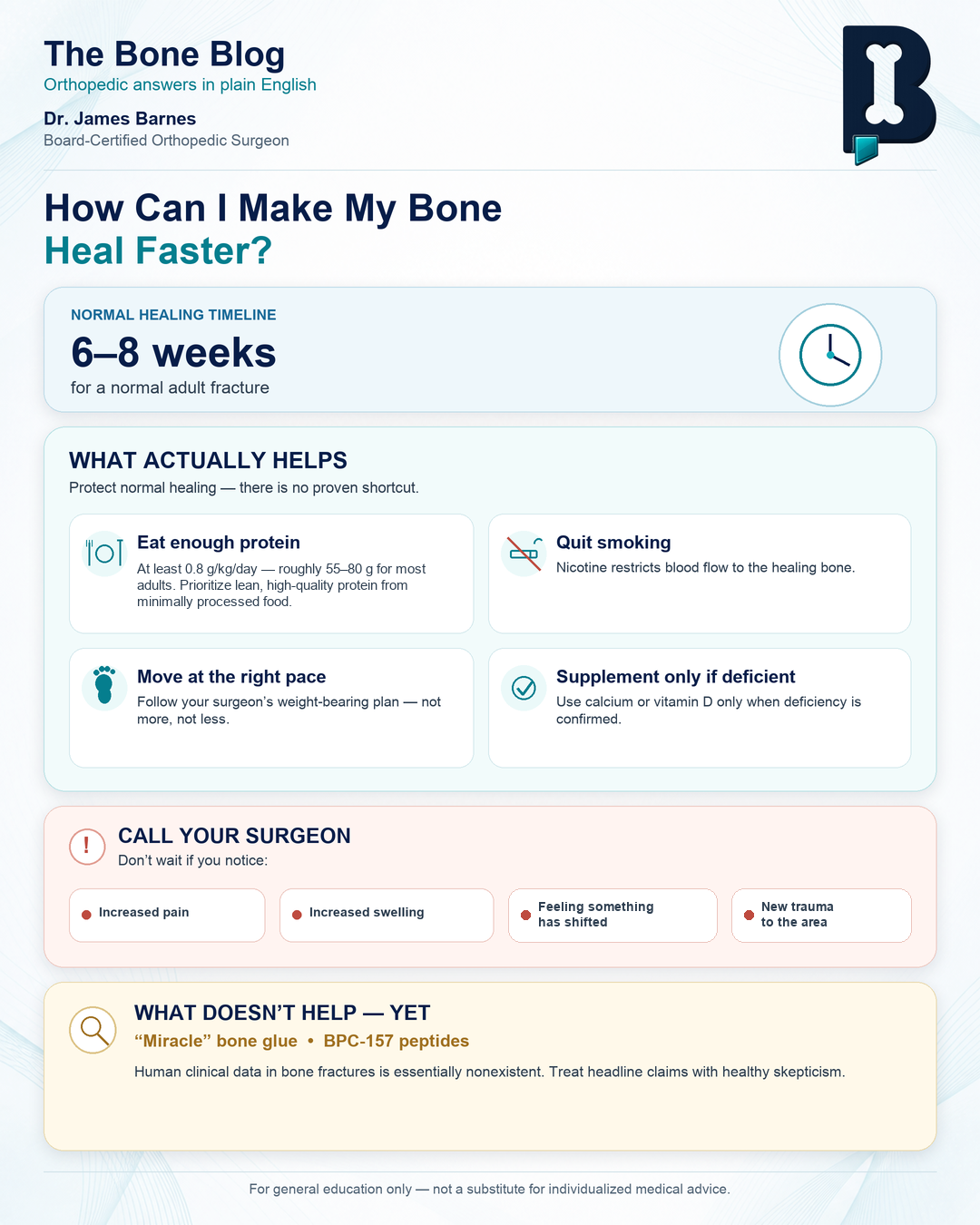
If you’ve just broken a bone, the honest answer is: you can’t make it heal dramatically faster than your body already plans to — but you can absolutely slow it down. According to Dr. James Barnes, an orthopedic surgeon in Lake Havasu City, normal adult bone healing takes about six to eight weeks. “The best thing you can do to make this heal faster is essentially not to slow it down,” he says.
That reframing matters, because it tells you where to actually spend your energy: not chasing gimmicks, but removing the handful of things that reliably get in biology’s way.
Why bone healing has a speed limit
Bone repairs itself in overlapping stages — inflammation, soft callus formation, hard callus mineralization, and remodeling — and each stage depends on a steady supply of nutrients, oxygen-rich blood flow, and the right amount of mechanical stress. According to PubMed, a large 2016 claims-database study of over 309,000 fractures found that smoking, prolonged NSAID and opioid use, obesity, diabetes, and vitamin D deficiency were all independently associated with higher odds of nonunion — the outcome you’re trying to avoid (Zura et al., JAMA Surgery, 2016; DOI: 10.1001/jamasurg.2016.2775). None of these factors makes healing faster when they’re absent; they just stop making it slower.
What actually helps
Eat real food, with enough protein. Current evidence supports at least 0.8 grams of protein per kilogram of body weight per day — roughly 55 to 80 grams for most adults. According to PubMed, research on bone health specifically has found that intake at or above that level is associated with higher bone density and lower fracture risk, particularly in older adults, provided calcium intake is also adequate (Rizzoli et al., Osteoporosis International, 2018; DOI: 10.1007/s00198-018-4534-5). Dr. Barnes tells patients to prioritize lean, high-quality protein from food that’s minimally processed rather than falling short of that baseline. Protein fuels the collagen synthesis your body needs to lay down new bone, and according to PubMed, malnutrition has been associated with roughly double the risk of nonunion in fracture patients (Velasquez-Hammerle et al., Bone, 2026; DOI: 10.1016/j.bone.2026.117837).
Quit smoking, starting now. Nicotine is a vasoconstrictor — it narrows the small blood vessels that carry nutrients to the fracture site. Dr. Barnes recalls a patient with a wrist fracture who used her injury as the push she needed to quit smoking for good; she went on to heal within the normal six-to-eight-week window and never went back to cigarettes. According to PubMed, that instinct is well-supported: smoking is one of several independent, modifiable risk factors for nonunion identified in large population studies (Zura et al., JAMA Surgery, 2016; DOI: 10.1001/jamasurg.2016.2775).
Only supplement what you’re actually short on. Calcium and vitamin D are essential for mineralizing new bone, but Dr. Barnes doesn’t routinely order vitamin D bloodwork on every fracture patient — only when healing looks slower than expected. “If you’re normal, the body will use those sources as the building blocks for good bone healing,” he says. If you are deficient, correcting it matters: according to PubMed, vitamin D deficiency has been linked to measurably higher nonunion risk (Jha et al., Cureus, 2025; DOI: 10.7759/cureus.97842).
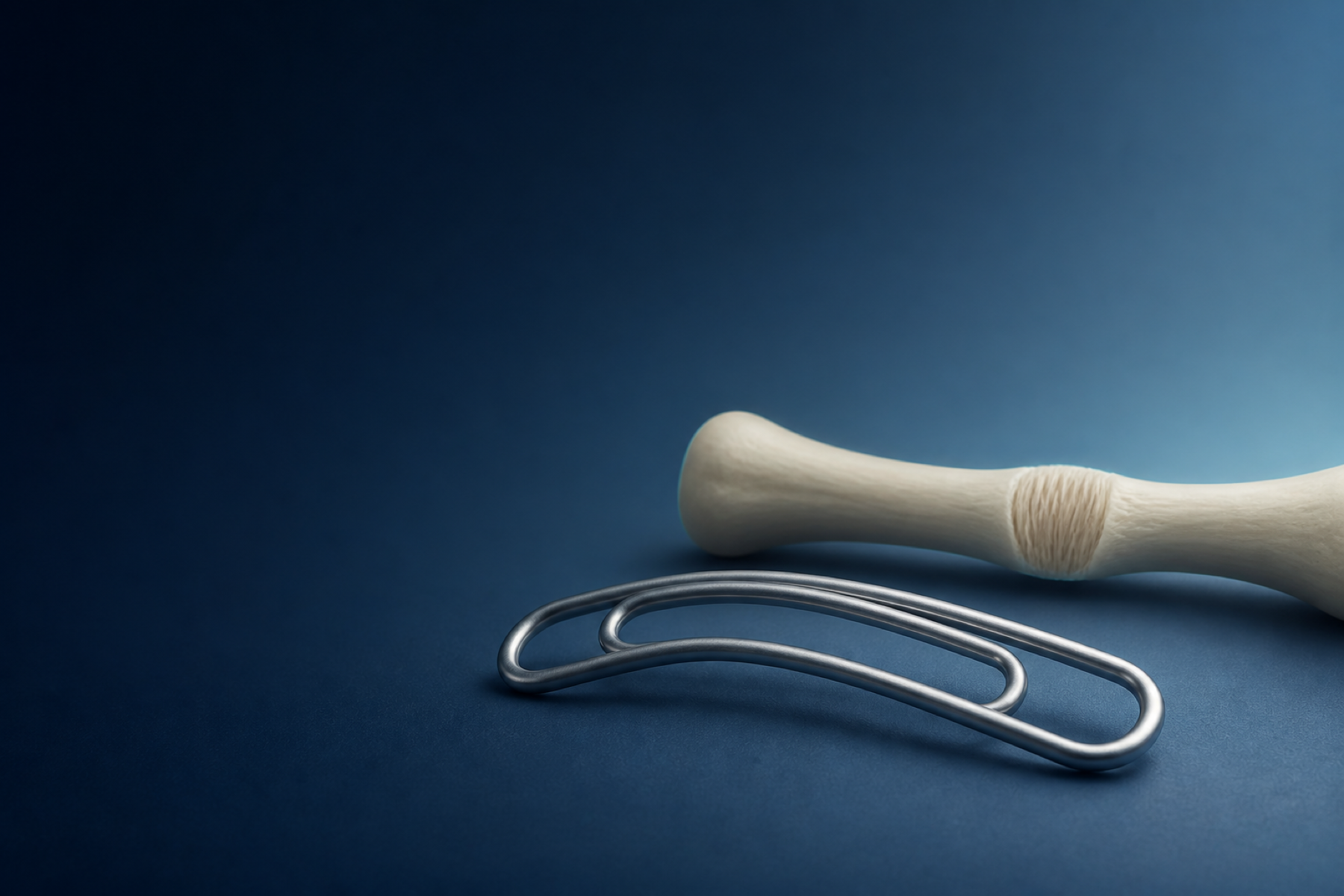
Move at the right pace, not the fastest one. Getting appropriate weight-bearing and mechanical loading back into a healing fracture is one of the more powerful tools available — but timing depends on the bone involved, how it was stabilized, the patient’s age and bone quality, and how much energy caused the break in the first place. Dr. Barnes describes it with a simple image: it’s like bending a paper clip back and forth — eventually it’ll fatigue if the load is more than the healing bone can handle. The same principle, in reverse, is Wolff’s Law: stress a bone appropriately and the body responds by building it stronger, a mechanism well documented in the mechanobiology literature on fracture repair (Anani & Castillo, Bone, 2021; DOI: 10.1016/j.bone.2021.116223).
What doesn’t help (yet)
Patients regularly ask Dr. Barnes about the latest headline: a “miracle” bone glue claiming to heal a fracture in minutes, or peptides like BPC-157 marketed online as a shortcut to faster recovery. His answer is consistent: “I really have to be careful with things that come out in a headline because oftentimes they’re just not backed up by the full story.” According to PubMed, current reviews of BPC-157 and similar peptides confirm human clinical data remains extremely limited — a handful of small pilot studies, none in bone fractures specifically — even though animal studies look promising (McGuire et al., Curr Rev Musculoskelet Med, 2025, DOI: 10.1007/s12178-025-09990-7; Mayfield et al., Am J Sports Med, 2026, DOI: 10.1177/03635465251357593). Bone growth stimulators (LIPUS) and platelet-rich plasma have real evidence behind them for delayed unions and nonunions specifically, but aren’t proven to speed up a normally healing fracture — so Dr. Barnes weighs cost, accessibility, and the strength of the evidence before recommending them to any individual patient.
When to call rather than wait
Dr. Barnes keeps a low threshold for bringing patients in: increased pain, increased swelling, a feeling that something has shifted, or any new trauma to the area are reasons to call rather than wait for your next scheduled visit. “I just want to lay eyes on it,” he says — sometimes what’s needed is simple reassurance, and sometimes it changes the plan.
The bottom line
There’s no proven way to dramatically outrun the six-to-eight-week timeline of normal bone healing. What you can do is protect it: eat enough protein, don’t smoke, load the bone appropriately as your surgeon directs, and correct any real nutritional deficiency. As Dr. Barnes puts it, “rushing biology is not something we have yet mastered in the scientific community.” The goal isn’t to force your body to go faster — it’s to give it everything it needs so nothing holds it back.
Visual summary
Frequently asked questions
How long does it normally take for a broken bone to heal?
For a normal adult fracture, plan on roughly six to eight weeks before it's healed enough for basic activity. Full recovery and return to sport or heavy activity can take longer depending on the bone, the fracture pattern, and how it was treated.
Do I need to take calcium and vitamin D supplements to heal faster?
Only if you're actually deficient. Dr. Barnes doesn't routinely order vitamin D bloodwork on every fracture patient — he checks it if healing looks slower than expected. If your levels are normal, your body will use the calcium and vitamin D you get from food as the building blocks for healing without extra supplementation.
How much protein should I be eating while I heal?
Current evidence supports at least 0.8 grams of protein per kilogram of body weight per day — roughly 55 to 80 grams for most adults. Research specifically on bone health suggests intake at or above that level is linked to higher bone density and lower fracture risk, especially in older adults, provided calcium intake is also adequate. Dr. Barnes recommends prioritizing lean, high-quality protein from minimally processed food rather than falling short of that baseline.
Is it safe to take ibuprofen or other NSAIDs for pain after a fracture?
Short-term use appears to be reasonably safe based on current evidence, but prolonged or high-dose NSAID use has been linked to a higher risk of delayed healing in some studies. Talk with your surgeon about the right pain plan for your specific fracture.
Will a bone stimulator, PRP injections, or peptides like BPC-157 speed up my healing?
Bone growth stimulators (LIPUS) and platelet-rich plasma (PRP) have real evidence behind them specifically for delayed unions and nonunions, but they aren't proven to speed up a fracture that's already healing normally. Peptides like BPC-157 and TB-500 are popular online, but human clinical data in bone fractures is essentially nonexistent — what exists is mostly animal research. Dr. Barnes recommends healthy skepticism toward anything promising a dramatic shortcut, especially products marketed directly to patients rather than studied in large clinical trials.
What are signs that my fracture isn't healing the way it should?
Increased pain, increased swelling, a feeling that something has shifted, or any new trauma to the injured area. Dr. Barnes keeps a low threshold for bringing patients in to check on these — sometimes it's simple reassurance, sometimes it changes the plan.
Can I put weight on my fracture before my doctor clears me?
Timing depends on the specific bone, how the fracture was stabilized, your age and bone quality, and how much energy caused the injury — it's individualized. Too much load too soon is like bending a paper clip back and forth: eventually it fatigues. Follow your surgeon's specific weight-bearing instructions.
Does smoking really affect how fast a bone heals?
Yes. Nicotine narrows the small blood vessels that carry nutrients to the healing bone, which slows delivery of what the fracture needs to rebuild. Quitting — even right after a fracture — measurably helps, and many patients use their injury as motivation to quit for good.
Need a joint checked?
If pain, instability, an injury, or mechanical symptoms are limiting your activity, an orthopedic evaluation can help clarify the cause.
Schedule an Appointment