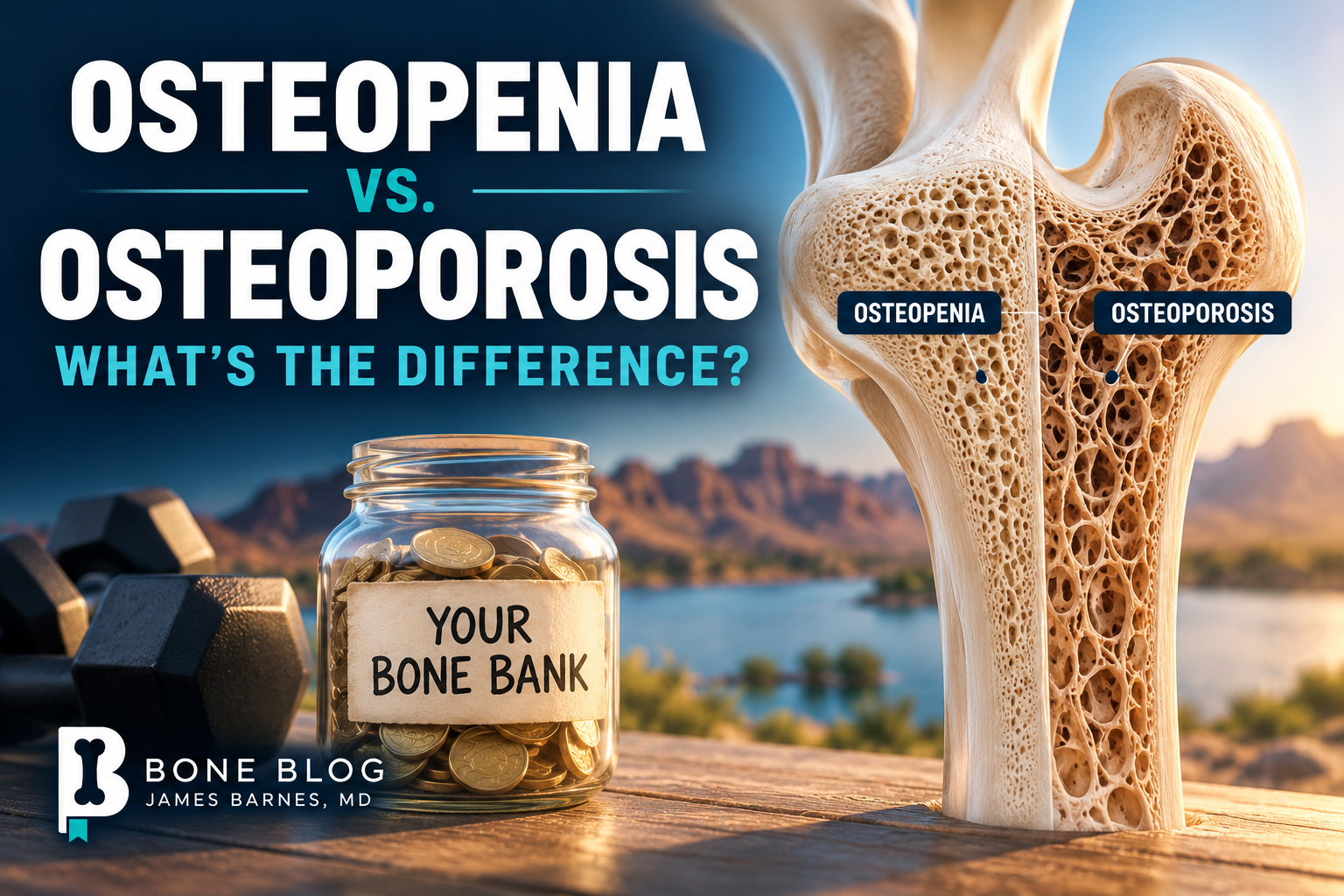
If your bone-density scan says “osteopenia,” does that mean you have osteoporosis? Not quite. Both describe lower-than-ideal bone mineral density, but osteoporosis meets a more severe diagnostic threshold. More importantly, your risk of breaking a bone depends on more than one test result.
Think of your bones as a savings account
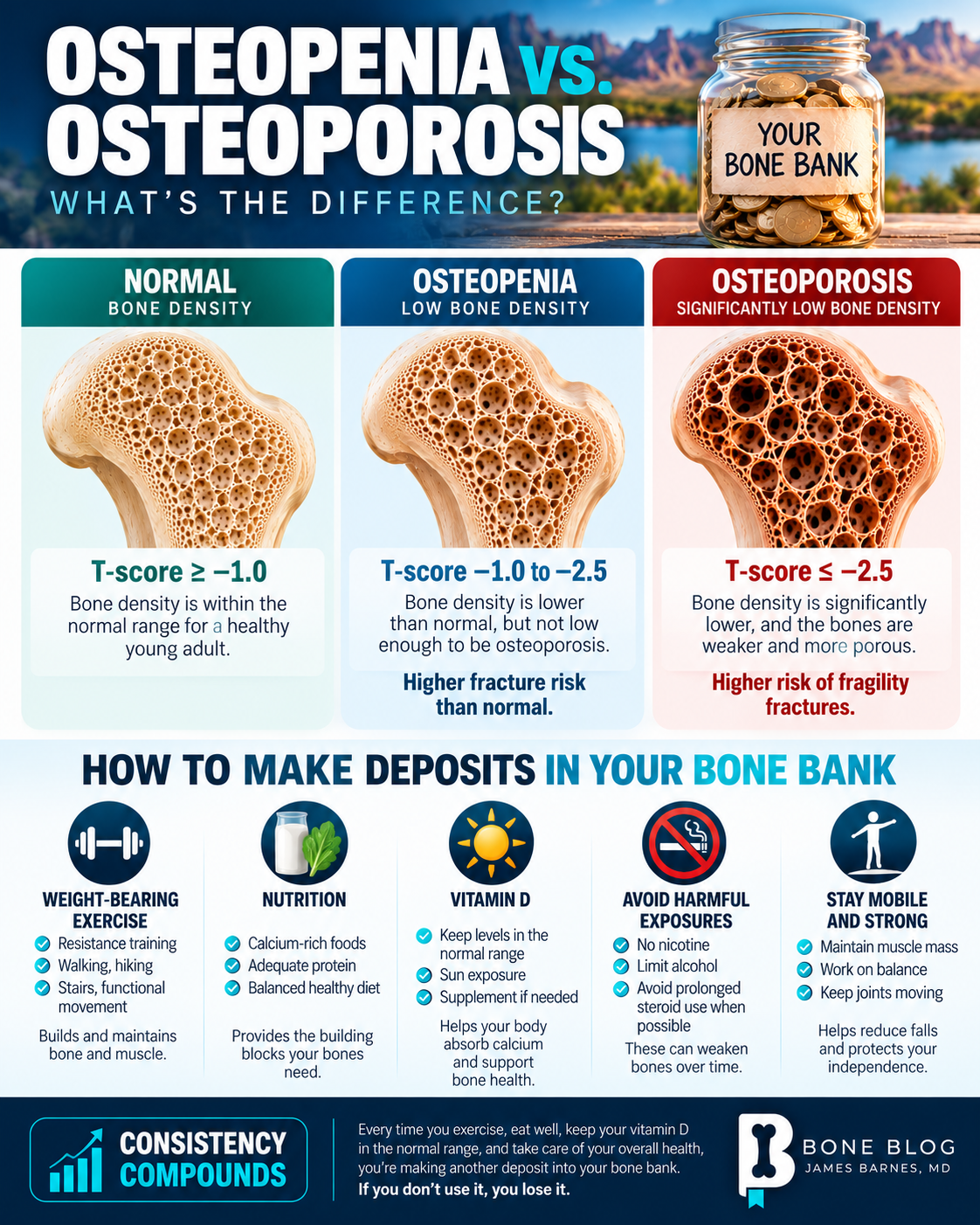
When we’re young, our bodies build up bone reserves. As we age, we may begin withdrawing bone faster than we’re depositing it. Osteopenia is a low-balance warning. Osteoporosis means those reserves have fallen further, placing us at greater risk of a fracture. The good news is that we can make smart investments in bone health. Strength training, sound nutrition, addressing underlying medical causes, fall prevention and, when indicated, medication can help protect bone and reduce fracture risk.
What do the DXA numbers mean?
DXA (sometimes spelled DEXA) measures bone mineral density, usually at the hip and lumbar spine. A T-score compares your density with a healthy young-adult reference population. In postmenopausal women and men aged 50 and older, T-scores of -1.0 or higher are generally considered normal; below -1.0 but above -2.5 means low bone mass (osteopenia); and -2.5 or lower meets the bone-density definition of osteoporosis. A Z-score compares with age-matched peers and is preferred in younger adults. Neither score captures the entire picture of bone strength or fall risk.
Why fractures matter more than labels
A wrist fracture after a fall from standing height can be an early warning. Hip fractures and vertebral compression fractures are especially consequential. A low-trauma fracture should prompt a discussion about bone-health testing and possibly laboratory evaluation, even if no one has previously mentioned osteoporosis. Certain fragility fractures can establish a clinical diagnosis of osteoporosis even when the T-score is above -2.5. Not every fracture automatically means osteoporosis: age, injury mechanism and site still matter.
Who should get screened?
The USPSTF recommends osteoporosis screening for women 65 and older and for postmenopausal women under 65 whose risk assessment indicates elevated fracture risk. For men, the USPSTF finds insufficient evidence for a universal screening recommendation; specialty guidance such as ISCD recommends bone-density testing at age 70, or sooner when risk factors are present. Patients with fragility fractures, prolonged glucocorticoid exposure or relevant medical conditions may need diagnostic evaluation regardless of routine screening age. Risk factors include low body weight, prior fracture, parental hip fracture, smoking and certain medications. Screening an asymptomatic person differs from evaluating someone who has already fractured a bone.
Can you rebuild your bone bank?
Bone is living tissue. Wolff’s law describes how bone adapts to mechanical loading. Progressive resistance training, appropriately selected weight-bearing or impact activity, and balance exercises are valuable parts of prevention. Walking supports fitness and mobility, but resistance and higher-impact loading, when medically safe, often provide a stronger bone-building stimulus. Exercise plans must be adapted for people with previous vertebral fractures, severe osteoporosis, pain or fall risk. Maintaining muscle strength helps combat sarcopenia, improves function and can reduce falls.
Calcium and vitamin D are important, but more isn’t always better. Aim for appropriate age- and risk-specific intake, preferably through food when feasible, and address deficiencies with your clinician. Check vitamin D levels when medically indicated rather than assuming everyone needs frequent testing or high-dose supplements. Avoid nicotine. Review steroid exposure and other potentially bone-affecting medications with the prescriber rather than abruptly stopping them.
Is it reversible? Do I need medicine?
Osteopenia and osteoporosis are treatable. Some patients improve their bone density enough to move into a different diagnostic category. Not everyone will, and the main goal is avoiding fractures rather than chasing a perfect number. When fracture risk is high, lifestyle measures alone may be insufficient. For U.S. postmenopausal women and men 50 and older, common treatment criteria include a hip or vertebral fragility fracture, a T-score of -2.5 or below, or low bone mass with sufficiently high calculated FRAX risk. Traditional U.S. FRAX treatment thresholds are a 10-year hip-fracture risk of at least 3% or major osteoporotic fracture risk of at least 20%, subject to clinical judgment and guideline updates. Prescription medications can meaningfully lower fracture risk; choices depend on health history, kidney function, fracture severity and preferences.
A team approach to bone health
I describe primary care as the air traffic controller of this process. Primary care can coordinate screening, medication review, lab tests and referrals. Endocrinology or a metabolic bone specialist can help with complicated diagnoses and medication choices. A registered dietitian can support nutrition. A physical therapist or qualified trainer can guide safe strengthening and balance work. As an orthopedic surgeon, I view a low-energy fracture as an opportunity to start the conversation, not simply fix a broken bone and move on.
What can cause low bone density?
Aging is only part of the story. Nicotine, low vitamin D, low sex-hormone levels, overactive thyroid or parathyroid disease, chronic kidney disease, malabsorption and prolonged systemic corticosteroid use can contribute. Your clinician may look for secondary causes, especially if bone loss is unexpected or particularly severe.
How do we know treatment is working?
Bone changes slowly. Repeated DXA studies are often considered about 1–2 years after starting or changing treatment, with subsequent intervals based on risk and whether results would change decisions. Use the same equipment when possible; small numerical shifts may reflect measurement variability. Fracture history, new symptoms, fall risk and medication adherence matter at least as much as a small change in T-score.
Start making deposits now
Here’s what I tell younger patients: train so that when you blow out the candles on your 90th birthday, you still have the strength, mobility and balance to live independently. You don’t need to be an elite athlete. You need consistent habits. If you don’t use it, you lose it. Make deposits into your bone bank today. Consistency is what compounds.
Next step
If you’ve had a fracture after a minor fall, or your bone-density report concerns you, bring the results to your primary care clinician and discuss your overall fracture risk and whether additional evaluation or treatment is appropriate. Explore other patient-friendly orthopedic articles on JamesBarnesMD.com.
References
- USPSTF. Osteoporosis Screening, 2025.
- ISCD. Official Positions, 2023.
- Bone Health & Osteoporosis Foundation. Clinician’s Guide.
This article is for general education and is not individualized medical advice.
Visual summary
Frequently asked questions
Is osteopenia just mild osteoporosis?
They are on the same continuum of bone loss, but osteopenia is a distinct DXA category and does not automatically mean osteoporosis.
Can osteopenia cause fractures?
Yes. Someone with osteopenia may still have high overall fracture risk, particularly after a previous low-trauma fracture.
Does osteoporosis always hurt?
No. Low bone density usually causes no symptoms until a fracture occurs.
Can lifting weights help?
Appropriate progressive resistance training may help preserve or improve bone density, muscle strength, and balance. Seek individualized guidance if you have high fracture risk or previous vertebral fractures.
Should I take calcium supplements?
Only if needed to meet your individual calcium intake goals. Food sources are preferred when feasible, and supplements can have downsides.
How often should I have a DXA scan?
The interval depends on your risk and treatment. Repeat scans are often considered after roughly 1–2 years when results may change care.
Need a joint checked?
If pain, instability, an injury, or mechanical symptoms are limiting your activity, an orthopedic evaluation can help clarify the cause.
Schedule an Appointment