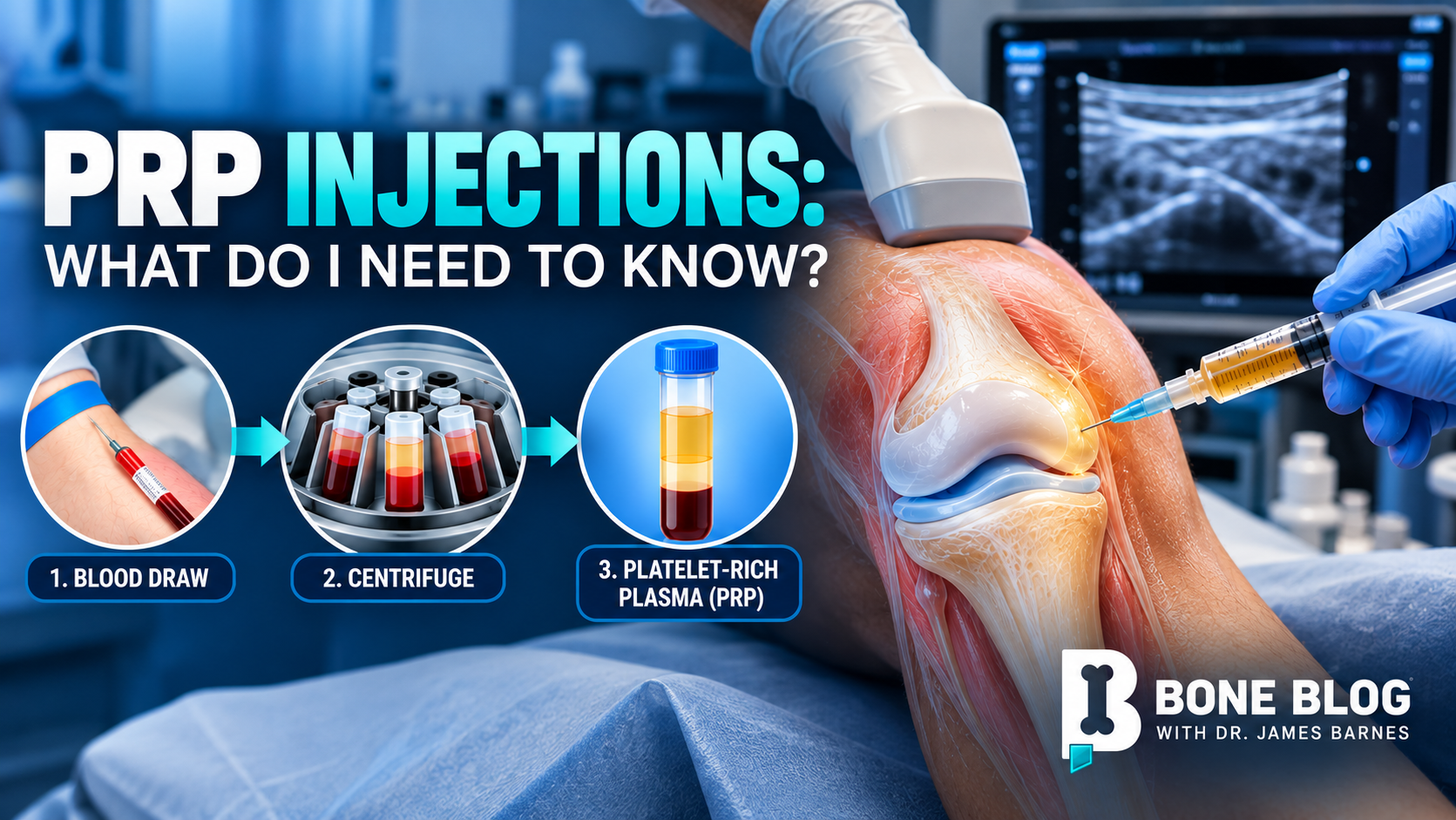
PRP can be a useful treatment for certain orthopedic conditions, but it is not one uniform treatment and it is not a miracle injection.
When I talk to patients about platelet-rich plasma, or PRP, I emphasize three things: the indication matters, the dose and preparation matter, and expectations matter.
The goal is to use your own platelets to create a concentrated biologic treatment that may support the body’s healing response. The evidence is encouraging for some orthopedic problems, mixed for others, and continues to evolve.
What is PRP?
PRP stands for platelet-rich plasma.
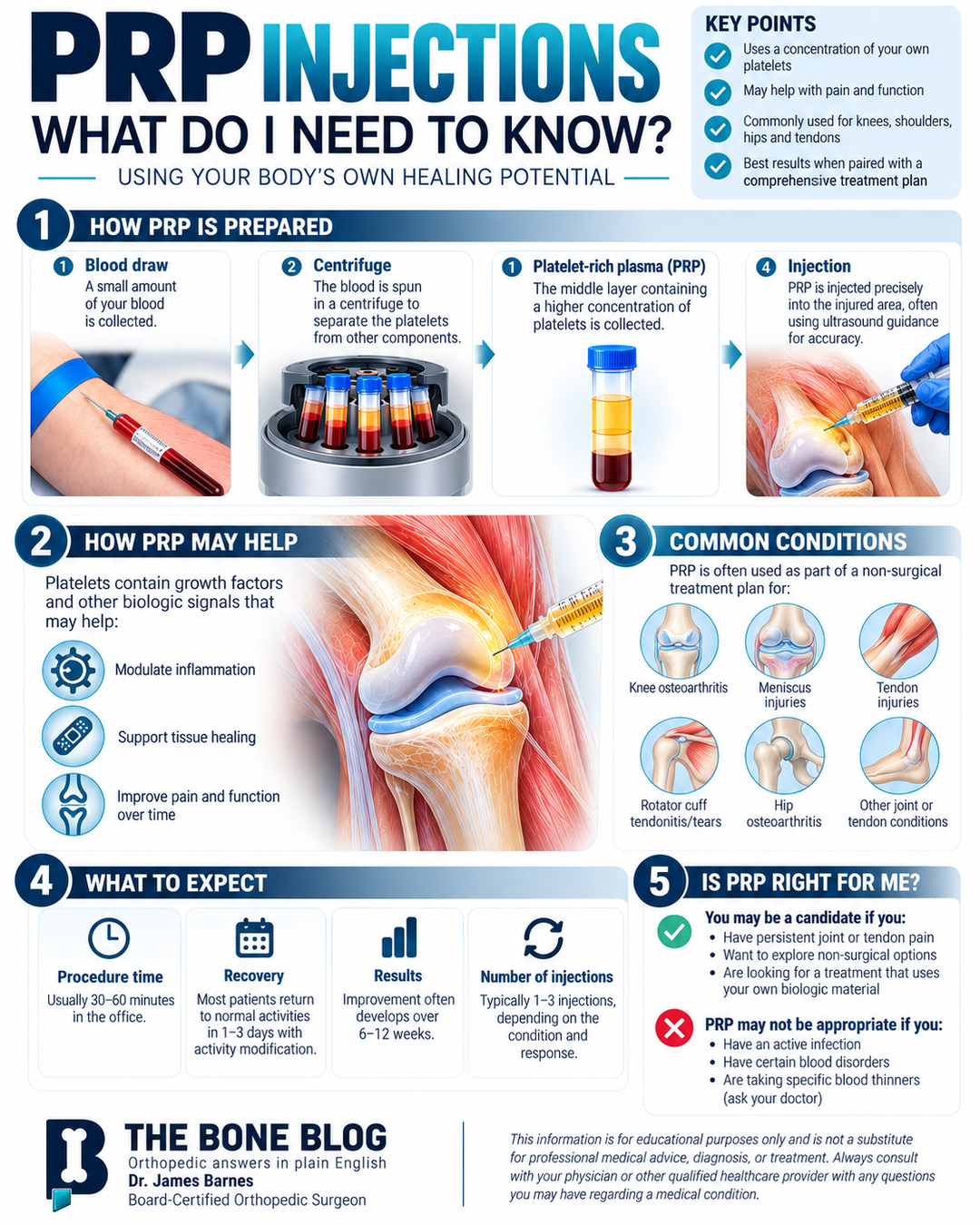
We draw your own blood and process it to separate and concentrate platelets. Platelets are best known for helping blood clot, but they also carry signaling proteins and growth factors involved in the body’s response to injury.
I typically draw around 100 cc of blood when preparing PRP. The exact preparation depends on what I am treating.
PRP can be prepared with different platelet concentrations and different concentrations of white blood cells, called leukocytes. In my practice, I generally use leukocyte-poor PRP inside a joint and may use leukocyte-rich preparations for selected tendon or ligament applications.
That variability matters because when two research studies say they studied “PRP,” they may not have studied exactly the same product.
With PRP, dose matters
One of the biggest changes in PRP research has been increased attention to what is actually being injected.
Early studies often treated PRP as though every preparation were equivalent. They are not.
Research increasingly suggests that the amount of platelets delivered can influence outcomes, particularly in knee osteoarthritis. But that does not mean that endlessly increasing platelet concentration is better. Researchers are still working to determine the optimal dose and formulation.
That is why I think patients should ask more than, “Do you offer PRP?”
A better question is: What PRP are you using, and why is that preparation appropriate for my problem?
What do I use PRP for?
In my practice, I consider PRP most often for selected patients with problems such as mild to moderate osteoarthritis and certain tendon injuries.
The important phrase is selected patients.
For knee osteoarthritis, there is a growing body of supportive research, but the results are not unanimous. One rigorous placebo-controlled trial did not find a significant advantage over saline at 12 months, while other meta-analyses have reported clinically meaningful improvement.
If you are trying to determine whether knee symptoms are coming from arthritis, a meniscus problem, or something else, start with Meniscus Tear vs. Knee Osteoarthritis. If stairs are one of the activities that reliably trigger your symptoms, Why Does My Knee Hurt on Stairs? explains some of the common patterns.
Evidence for tendons is even more condition-specific. PRP should not be described as universally effective for every “tendinitis.” Achilles, patellar tendon, elbow, and rotator cuff research have produced different results.
For partial-thickness rotator cuff tears, PRP may improve symptoms in some patients, but the evidence for durable functional improvement remains mixed.
PRP used during rotator cuff repair is particularly interesting. Multiple analyses suggest PRP augmentation may lower the risk of re-tear in some settings, although results depend partly on preparation and technique.
What can’t PRP fix?
This may be even more important than knowing what PRP can treat.
Sometimes we are asking biology to do too much heavy lifting.
Imagine a completely torn and retracted rotator cuff tendon. PRP may influence the biological environment, but it cannot build a bridge across the Mississippi River. If two pieces of tissue are physically separated and the problem is fundamentally mechanical, an injection cannot simply reconnect them.
The same concept applies to severe end-stage arthritis. PRP may have a role in symptom management for selected patients, but it cannot reconstruct a joint whose mechanical structure has substantially failed.
Patient selection matters.
What should I expect after PRP?
PRP is very different from a cortisone injection.
Cortisone can sometimes provide relatively rapid pain relief. I describe it as “fast on, fast off,” although how long it lasts varies considerably.
PRP works through biological processes that take time.
I tell my patients not to expect immediate improvement. The treated area can actually become more uncomfortable for a period after the injection. Improvement, when it happens, generally develops over the following weeks rather than hours or days.
My post-injection protocol commonly includes acetaminophen if needed for discomfort and avoiding NSAIDs around the procedure because some NSAIDs can affect platelet function. The ideal medication-free interval has not been definitively established, so protocols vary.
Never stop aspirin, anticoagulants, or prescribed antiplatelet medication simply because you are considering PRP. Those medications may be protecting you from a blood clot, heart attack, stroke, or another serious problem. Any change needs to be individualized and coordinated with the clinician who prescribed it.
PRP versus cortisone and gel injections
These treatments do different things.
Corticosteroid injections can provide relatively rapid symptom relief. However, repeated scheduled corticosteroid exposure is not biologically neutral. A randomized trial involving triamcinolone every three months for two years found greater cartilage loss than saline without better pain outcomes. That does not mean an occasional cortisone injection inevitably damages a joint.
Hyaluronic acid, often called a “gel injection,” is another option for knee osteoarthritis.
I sometimes combine PRP with hyaluronic acid in selected patients. Research suggests the combination may provide additional benefit in some studies, but there is disagreement about how clinically meaningful that added benefit is compared with PRP alone.
Why isn’t PRP usually covered by insurance?
I wish PRP had broader insurance coverage.
From an evidence standpoint, one challenge is that PRP is not standardized. Different systems produce different platelet concentrations, leukocyte concentrations, volumes, and final products. Studies also disagree about effectiveness for some conditions.
That makes PRP difficult to evaluate as though it were one standardized medication.
I gained a significant amount of my PRP experience while serving on active duty, where we had a dedicated PRP injection clinic. I also used orthobiologics during my sports medicine fellowship at UCLA while caring for collegiate and professional athletes.
That experience shaped how I think about orthobiologics today: they are tools, not magic.
I take a similarly skeptical approach to newer regenerative claims. If you are curious about that broader category, see What an Orthopedic Surgeon Thinks About Peptides.
A PRP story that’s personal to me
One of the patients who influenced my perspective most was my own mother.
She developed an ankle tendon problem, and we discussed several treatment options. Ultimately, PRP became part of her treatment program. She improved without needing surgery.
That is one patient, and one patient’s experience does not prove that a treatment works.
But I have also seen patients return to golf, tennis, walking, running, military readiness, and competitive athletics after treatment programs that included PRP.
Those experiences are why I remain interested in PRP while still being careful about whom I recommend it to.
So, is PRP worth it?
Sometimes.
My approach is simple:
Right patient. Right indication. Right preparation. Right dose. Realistic expectations.
When those pieces line up, I have seen excellent results. When they do not, PRP can become an expensive treatment being asked to solve a problem it was never capable of fixing.
If you are considering PRP, the first question should not simply be, “Can I get PRP?”
It should be: “Is PRP the right treatment for my particular problem?”
An orthopedic evaluation can help answer that question before you spend your money.
References
- Bennell KL, et al. PRP vs placebo for knee osteoarthritis. JAMA. 2021.
- Bensa A, et al. Platelet concentration and clinically meaningful outcomes after PRP for knee osteoarthritis. 2025.
- Simental-Mendía M, et al. Platelet concentration and knee osteoarthritis outcomes. 2025.
- Frey C, et al. Antiplatelet and NSAID effects on PRP. Orthopaedic Journal of Sports Medicine. 2020.
- Gill S, et al. PRP augmentation in rotator cuff repair. 2025.
- Gao J, et al. PRP plus hyaluronic acid for knee osteoarthritis. 2024.
- Yudtanahiran N, et al. PRP plus hyaluronic acid versus PRP alone. 2025.
- McAlindon TE, et al. Repeated intra-articular triamcinolone versus saline in knee osteoarthritis. JAMA. 2017.
This article is for general educational purposes and is not a substitute for a diagnosis or treatment plan from your own physician.
Visual summary
Frequently asked questions
Is PRP a stem cell treatment?
No. PRP is made from your own blood and concentrates platelets and associated signaling proteins. It should not be marketed as a stem cell injection.
Does PRP regrow cartilage?
PRP should not be promised to regrow lost cartilage. In osteoarthritis, the clinical evidence is primarily about pain and function rather than proven cartilage restoration.
How quickly does PRP work?
PRP is not an immediate anesthetic. Dr. Barnes generally counsels patients that improvement, when it occurs, develops over the following weeks rather than immediately.
How long does PRP last?
There is no universal duration. Results vary by diagnosis, disease severity, preparation, rehabilitation, and patient factors.
Is PRP better than cortisone?
Not universally. Cortisone and PRP work differently and have different tradeoffs. The better option depends on the condition being treated and the goals of treatment.
Can PRP prevent surgery?
Sometimes PRP can be part of a nonsurgical treatment program, but it cannot correct every structural problem. A mechanically failed tendon or severely damaged joint may need a different treatment.
Is PRP covered by insurance?
Often it is not, although coverage varies. Patients should verify benefits with their individual insurer before treatment.
Should I stop medications before PRP?
Do not stop prescribed medications on your own. NSAIDs, antiplatelet drugs, and anticoagulants require individualized consideration and coordination with the prescribing clinician.
Need a joint checked?
If pain, instability, an injury, or mechanical symptoms are limiting your activity, an orthopedic evaluation can help clarify the cause.
Schedule an Appointment