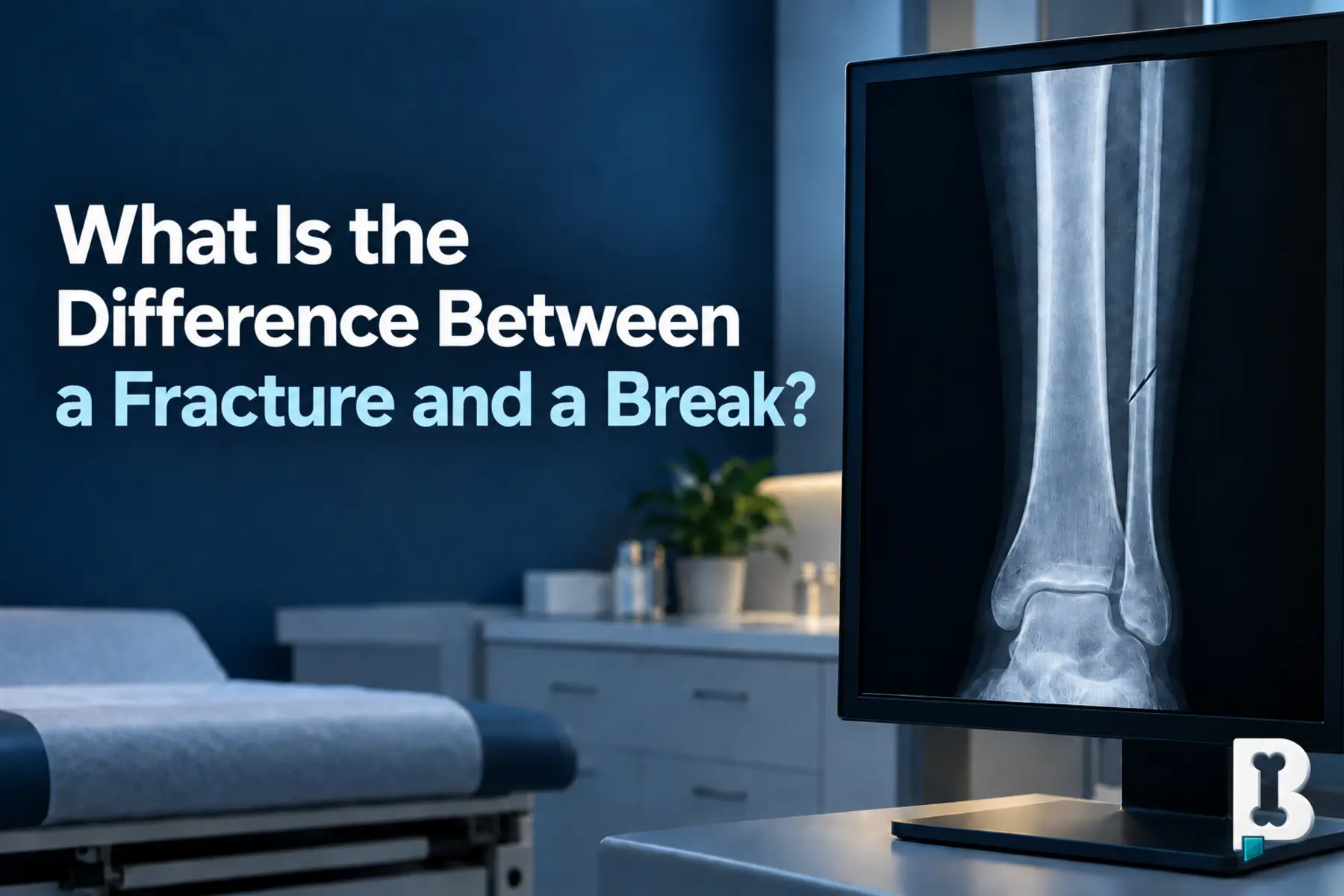
If you’ve ever been told you have a “fracture” and quietly wondered whether that’s better or worse than a “broken bone” — here’s your answer: they’re the exact same thing. A fracture is simply the medical term for a break. There’s no injury called a “fracture” that’s somehow milder than one called a “break.” Same injury, two different words.
Why the confusion exists. It’s an incredibly common misunderstanding — a questionnaire of orthopedic clinic patients found they were much more likely to correctly define “broken bone” than “fractured bone.” The word “fracture” sounds more clinical, so it’s easy to assume it means something more precise or less serious. In reality, “fracture” covers everything from a hairline stress fracture to a bone shattered into a dozen pieces — the word itself tells you nothing about how bad the injury is.
Dr. James Barnes, a board-certified orthopedic surgeon in Lake Havasu City, hears this question constantly. “Fracture is just the medical word for break — same way ‘laceration’ is the medical word for cut,” he explains. “It’s not a different injury, it’s not milder, it’s just what we call it on your chart.” He often uses a simple picture to make it click: “Think of a pencil. If I snap it clean in half, that’s a break — or in medical terms, a fracture. If it just cracks partway without separating, that’s still a fracture too, just a different type. The word doesn’t tell you how bad it is — I’ll tell you that separately based on what I see on the X-ray.”
What actually matters: the descriptive words. If “fracture” and “break” aren’t the useful distinction, what is? The words your doctor uses around those terms — that’s where the real information lives:
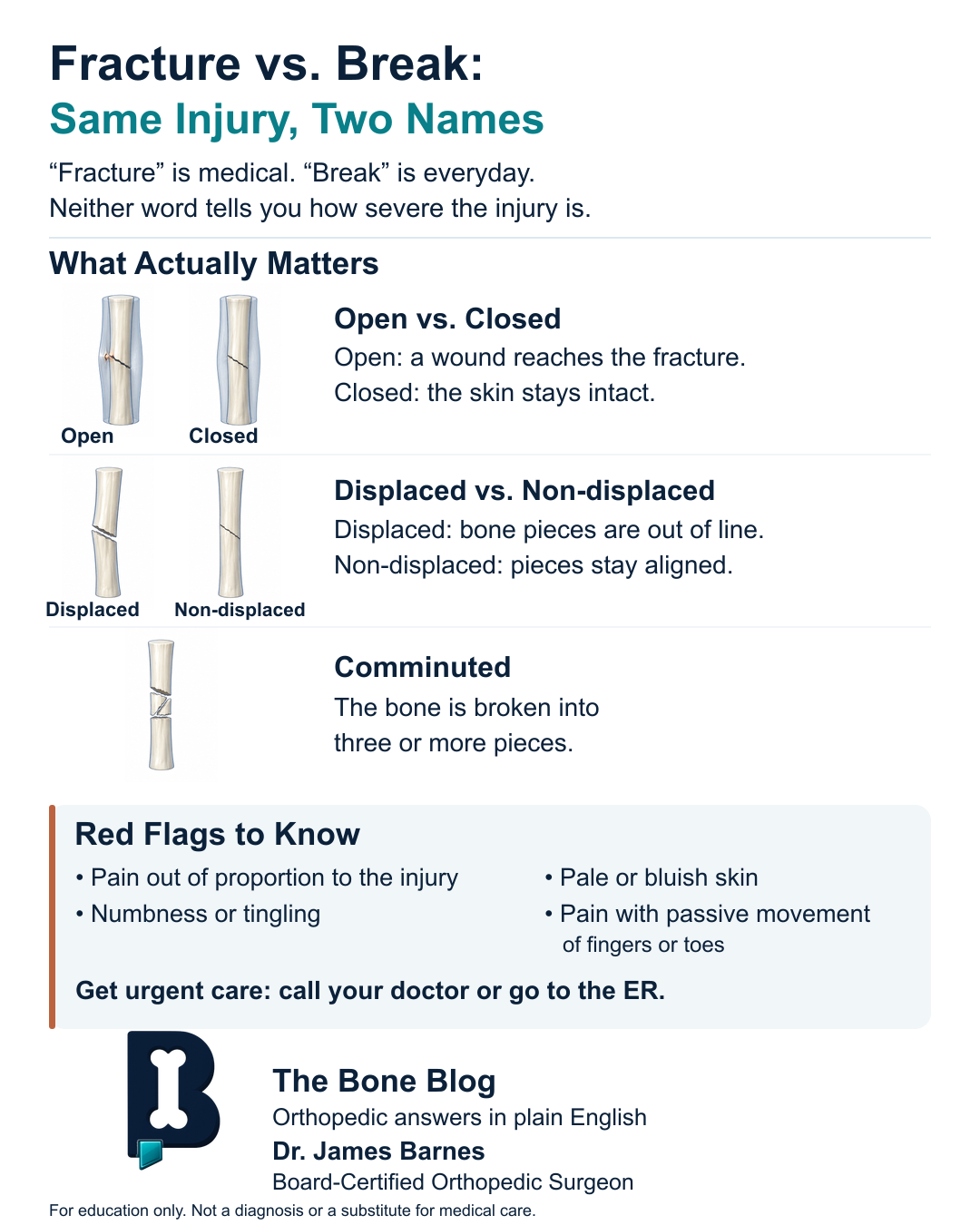
- Open vs. closed — An open (or “compound”) fracture has a wound that communicates with the broken bone, whether or not bone is visible through the skin. It needs urgent assessment, antibiotics, and a surgical treatment plan because of infection risk. A closed fracture means the skin stays intact, even if there’s significant swelling or bruising underneath.
- Displaced vs. non-displaced — Non-displaced means the bone pieces are still lined up correctly, like a cracked plate that’s still holding together — these often heal well in a cast or brace. Displaced means the pieces have shifted out of alignment and typically need to be repositioned, sometimes surgically.
- Comminuted — The bone has broken into multiple pieces, like a shattered plate. Generally a more involved injury than a simple two-piece break.
- Intra-articular fracture — The break extends into the joint surface, which can affect treatment and recovery. A fracture-dislocation means there is a fracture along with a dislocated joint.
“Those descriptive words are a lot more telling of the nature of the fracture — and what may be indicated as far as treatment goes — rather than just ‘is it broken or fractured,’” Dr. Barnes says.
Red flags after any fracture. Regardless of what the injury is called, there are warning signs worth knowing. The most urgent is compartment syndrome — dangerous pressure buildup around the fracture that can damage tissue within hours if untreated. Dr. Barnes uses residency shorthand to remember the signs: severe pain out of proportion to the injury, pain with passive stretch of the fingers or toes, and a tense swollen compartment. Numbness or weakness may follow; loss of a pulse is often a late sign. He also watches how tense the muscle feels around the injury: “I explain it to families like the casing on a sausage — that’s the fascia around the muscle. When bleeding gets into that muscle, the casing can’t expand, so pressure builds and clamps down on the nerves and blood vessels.”
Other signs to call your doctor about: increasing pain not controlled by medication, new swelling or redness, a cast that feels too tight or has been damaged, or drainage from a wound. Sudden chest pain, shortness of breath, or a fully numb, cold, or blue-tinted limb are reasons to go straight to the ER.
What can slow healing. A handful of everyday factors affect how well a fracture heals. Smoking is the one Dr. Barnes says patients are most reluctant to hear about, but it’s consistently linked to a higher rate of healing complications — a fracture is often a good moment to cut back or quit. Diabetes management matters too; good glycemic control supports better bone healing. NSAIDs (ibuprofen, naproxen) are a nuanced one: Dr. Barnes often asks patients to avoid them early after a fracture, then reassesses after about two weeks. The choice depends on the fracture, dose, duration, and your other health risks.
The bottom line. A fracture and a break are the same injury, described two different ways — one medical, one everyday language. If you’re ever unsure what a term your doctor used actually means, ask. As Dr. Barnes puts it, this is meant to be “an introductory gateway to the language of orthopedics” — so the next visit, you’re not just hearing the diagnosis, you’re understanding it.
This article is for general educational purposes and isn’t a substitute for a diagnosis or treatment plan from your own physician.
References
- Bagley CHM, et al. Patients’ misunderstanding of common orthopaedic terminology (2011)
- von Keudell AG, et al. Acute extremity compartment syndrome (2015)
- Hernandez RK, et al. Fracture-healing complications (2012)
Visual summary
Frequently asked questions
Is a fracture worse than a broken bone?
Neither. They are two names for the same injury. The descriptive terms and imaging tell you about severity.
What does displaced mean?
The bone fragments have shifted out of alignment. Treatment depends on the bone, amount of displacement, joint involvement, and patient factors.
What is an open fracture?
An open fracture has a wound communicating with the broken bone. It needs urgent medical assessment because of infection risk.
What is the difference between an intra-articular fracture and a fracture-dislocation?
An intra-articular fracture extends into the joint surface. A fracture-dislocation combines a fracture with displacement of the joint.
Need a joint checked?
If pain, instability, an injury, or mechanical symptoms are limiting your activity, an orthopedic evaluation can help clarify the cause.
Schedule an Appointment