
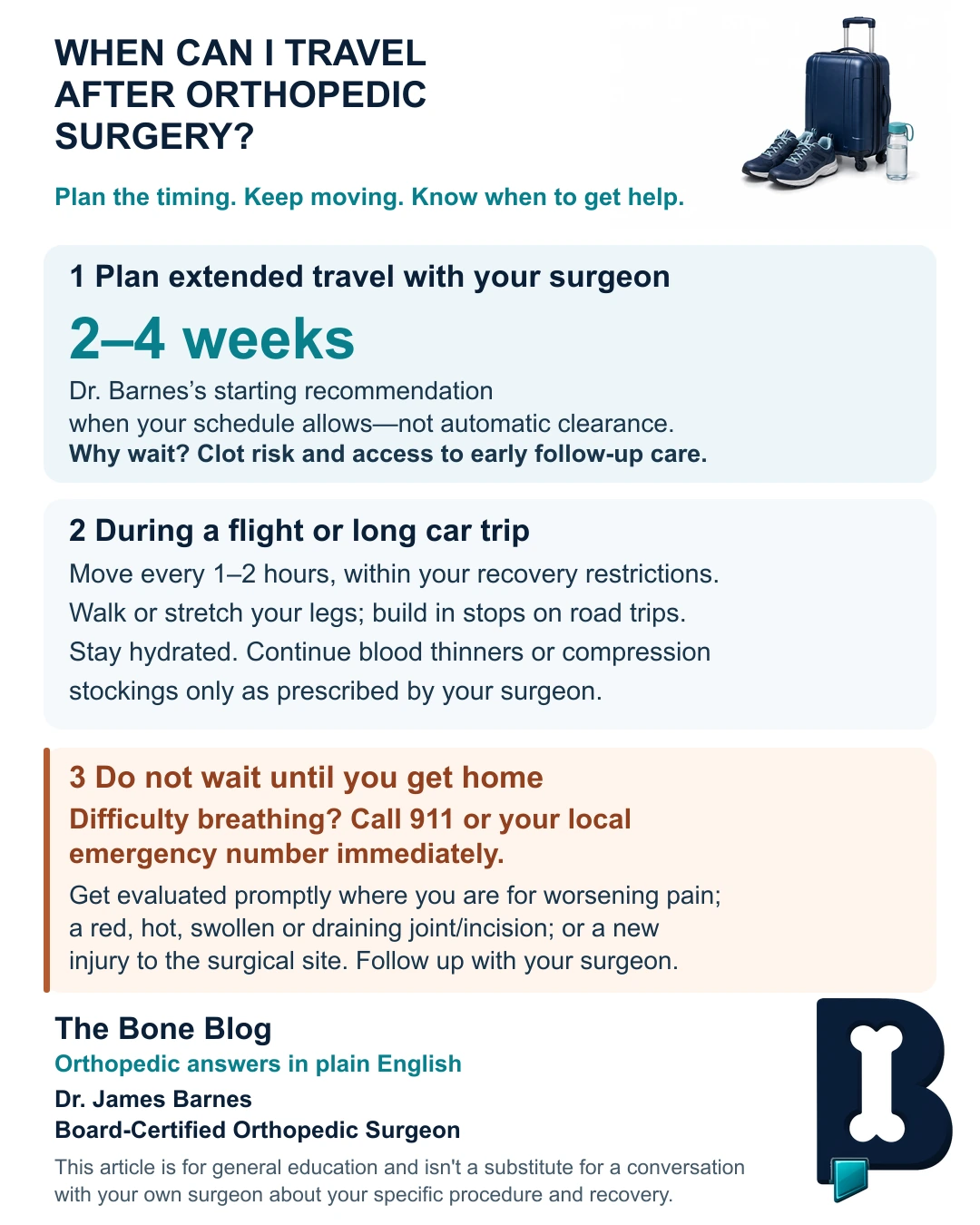
If you’re asking when you can fly or take a long drive after orthopedic surgery, my short answer is: give it two to four weeks if your schedule allows it. That is the window I recommend to my own patients before extended travel after joint replacement, fracture surgery, or an arthroscopic procedure.
That timing is a starting recommendation, not automatic clearance. If you cannot wait that long, talk with your surgeon about your procedure, recovery, mobility restrictions, and individual risks before you travel.
Why I recommend waiting
There are two main reasons behind my two-to-four-week guidance, and the second one surprises many patients.
The first is the one most people expect: sitting still for long stretches, whether in an airplane seat or a car seat, slows blood flow in the legs and can contribute to blood clots. Surgery and individual health factors can add to that risk.
The second reason is access to early follow-up care. The first couple of weeks after surgery are when wound problems, infection, and concerns about how a joint or fracture is healing may become apparent. I would rather examine you than try to troubleshoot a new problem by phone while you are several states away. Staying close to home during that early period makes it easier to identify and treat a problem promptly.
Warning signs while you are traveling
Call 911 or the local emergency number immediately for difficulty breathing, chest pain, fainting, or another possible medical emergency.
Get evaluated promptly where you are if you develop:
- Pain that is getting worse instead of better
- A joint or incision that is red, hot, increasingly swollen, or draining
- Fever or chills with a worsening surgical-site concern
- A new injury or trauma to the surgical site
- New calf pain or one-sided leg swelling
Do not wait until you get home to have a concerning change checked. An emergency department or appropriate local clinic can evaluate you, and you can follow up with your surgeon afterward.
If you have to travel sooner
Sometimes a flight is already booked or a trip cannot be postponed. Start by calling your surgeon. If travel is reasonable, move often within your recovery restrictions. On a long flight or drive, I generally suggest changing position and walking or stretching the legs every one to two hours. On a road trip, build in stops rather than trying to complete the drive in one stretch.
Stay hydrated. Continue a blood thinner or compression stockings only if they were prescribed for you, and use them exactly as directed. Do not let generic travel advice override weight-bearing, bracing, or range-of-motion restrictions from your surgical team.
The trip to surgery and the trip home afterward are not the same. After an operation, pain, medication effects, limited mobility, and a higher need for stops may make the return trip more demanding.
How I evaluate travel in clinic
When a patient asks about an upcoming trip, I consider the procedure, how recovery is progressing, blood-clot risk factors, mobility, the length of the trip, and the availability of follow-up care. A short drive two weeks after a shoulder scope is a different situation from an international flight two weeks after a hip replacement.
I do not use one rule for every patient. I use two to four weeks as a practical starting point, then adjust based on the person and the operation.
Some postoperative protocols have also changed. Traditional hip precautions are not applied in exactly the same way for every patient or surgical approach. Follow the restrictions given by your own surgeon rather than assuming that someone else’s recovery plan applies to you.
Most of my joint replacements are now performed as outpatient procedures, with patients going home the same day. That is a major change from the two- or three-night hospital stays that were common years ago, but outpatient surgery does not eliminate the body’s healing timeline.
When I recommend postponing travel
For many patients, the plan is straightforward: stay local for two to four weeks, move frequently if earlier travel is necessary and approved, and know the warning signs. I may recommend waiting longer after a complex procedure, a difficult first week, a wound concern, limited mobility, a history of blood clots, or another medical issue that raises risk.
The goal is not to keep you from traveling. It is to avoid turning a manageable recovery concern into a larger problem far from your surgical team.
A note for snowbird patients
Many of my patients divide the year between Lake Havasu and another home. When you leave for the season, take your operative report, medication list, and relevant imaging with you. If another clinician needs to evaluate you, those records provide a clearer picture of the procedure and recovery.
If follow-up imaging is due before a trip, your surgeon may recommend an X-ray. A CT scan may be used when bone healing is uncertain, while the expected pace of bone healing varies by injury and patient.
The bottom line
Travel after orthopedic surgery is something to plan for, not automatically fear. Give yourself two to four weeks before extended travel if you can, ask your surgeon before an early trip, move within your recovery restrictions, and know which warning signs require care where you are.
This article is for general education and is not a substitute for advice from your own surgeon about your procedure and recovery.
References
- Elmenawi KA, et al. When Is It Safe for Patients to Travel by Air After Total Joint Arthroplasty? JBJS Reviews. 2025.
- Cooper HJ, et al. Early Postoperative Outcomes of Primary Total Hip Arthroplasty After Discontinuation of Traditional Postoperative Precautions. Journal of Arthroplasty. 2014.
- Oputa TJ, et al. A Systematic Review of Patient-Related Risk Factors for Thrombosis After Orthopedic Surgery. Cureus. 2023.
- Crompton J, et al. Air Travel and Venous Thromboembolism After Hip and Knee Arthroplasty. Acta Orthopaedica. 2020.
- Clarke MJ, et al. Compression Stockings for Preventing Deep Vein Thrombosis in Airline Passengers. Cochrane Database of Systematic Reviews. 2021.
- Ishaku Z, et al. Air Travel After Joint Arthroplasty: A Review of the Evidence and Current Recommendations. Cureus. 2025.
Visual summary
Frequently asked questions
Is it safe to fly after a hip or knee replacement?
Many patients can fly after joint replacement, but the timing is individual. Dr. Barnes generally uses two to four weeks as a starting recommendation for extended travel, then considers the procedure, recovery, clot risk, mobility, and trip length.
Will my new joint set off airport metal detectors?
A hip or knee implant may lead to additional screening. Tell the TSA officer about the implant before screening and allow extra time. A TSA notification card is optional and does not replace screening.
Do I need a note from my surgeon to fly?
Usually not for TSA screening, but an airline may have its own medical-clearance rules for travel soon after surgery. Check with the airline and your surgeon before a trip in the early recovery period.
What if I have to travel before the two-to-four-week mark?
Talk with your surgeon first. If the trip cannot be postponed, follow your weight-bearing and movement restrictions, move or stretch regularly, stay hydrated, and use blood thinners or compression stockings only as prescribed.
Can I travel if I had outpatient surgery?
Outpatient surgery does not eliminate the healing timeline or clot risk. Going home the same day does not by itself mean you are ready for an extended flight or drive.
Need a joint checked?
If pain, instability, an injury, or mechanical symptoms are limiting your activity, an orthopedic evaluation can help clarify the cause.
Schedule an Appointment