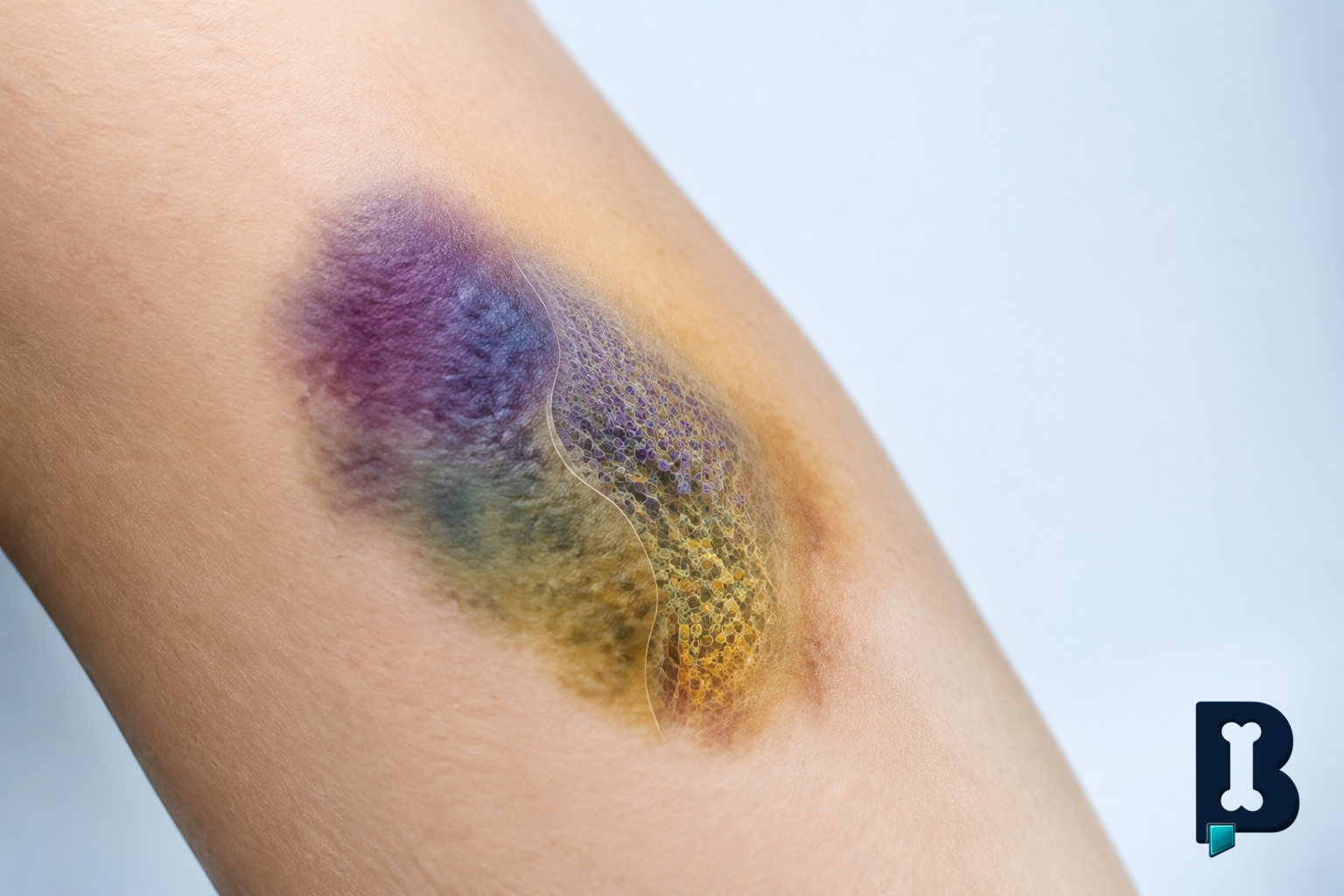
A bruise can look more dramatic before it looks better. A spot that began red or purple may become blue, green, yellow, or brown. More than one color may appear at the same time.
That changing palette is usually evidence that the body is processing blood trapped beneath the skin. It is not a dependable clock.
I often tell patients that bruises are normal, and normal bruises should act normally. A routine bruise has an understandable cause, some expected soreness, gradual change, and steady improvement. A bruise that is unexplained, rapidly expanding, increasingly painful, or affecting circulation or sensation needs another set of trained eyes.
What is a bruise?
A bruise forms when an impact or other injury damages small blood vessels without opening the skin. Blood escapes into the surrounding soft tissue. The medical term ecchymosis describes visible skin discoloration; a hematoma is a more localized collection of blood that may feel raised or firm.
The visible mark does not always sit directly over the injured structure. Blood can move along soft-tissue and muscle planes before it becomes visible at the skin.
Why does the color change?
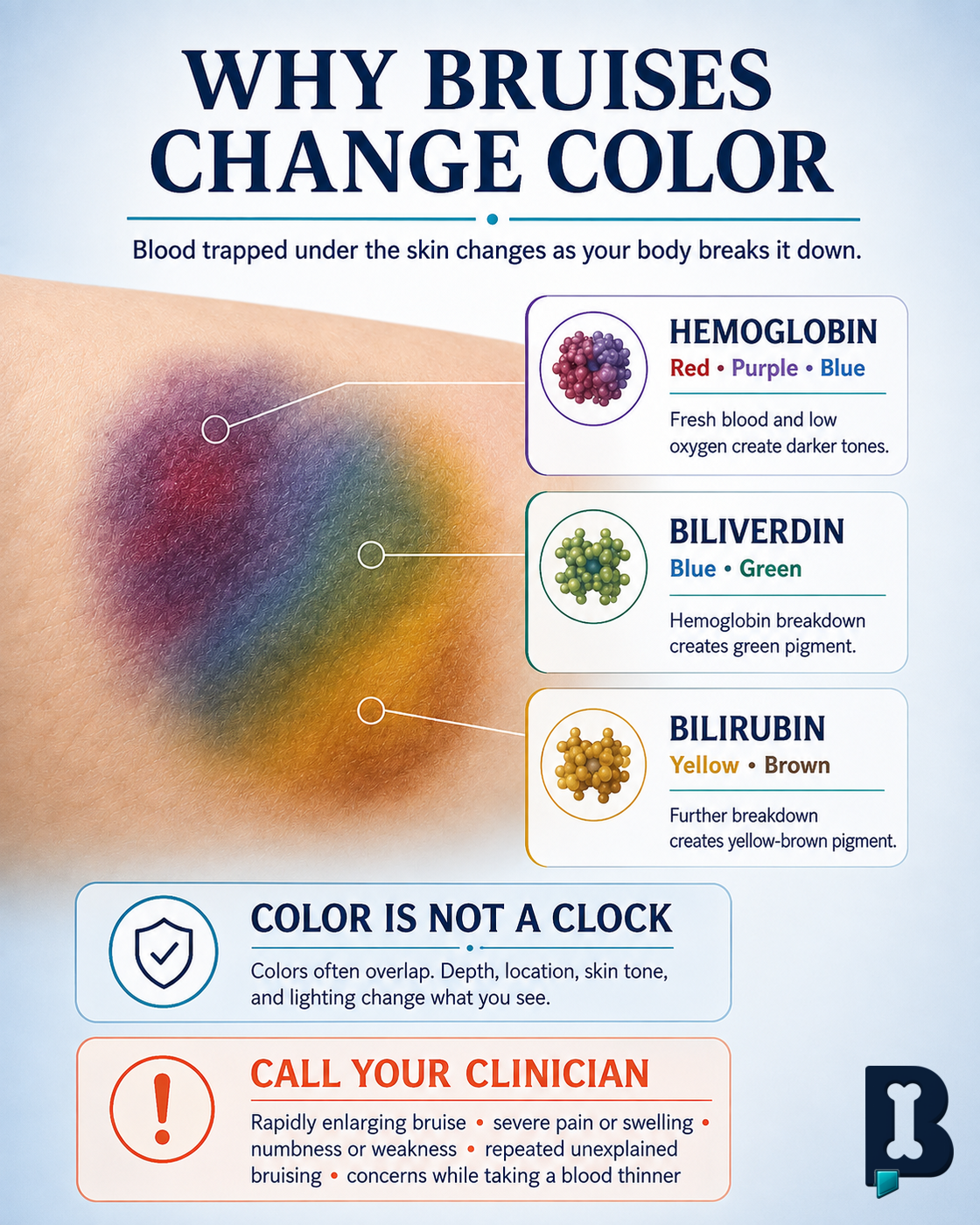
Red blood cells carry hemoglobin, the protein that transports oxygen. Once blood leaves the vessels and red cells break down in tissue, hemoglobin is exposed to a different chemical environment. It is oxidized, taken up by cleanup cells called macrophages, and converted into other pigments.
That process produces the familiar range of colors:
- Red or dark red: Fresh blood and oxygenated hemoglobin may dominate early.
- Blue or purple: The appearance changes as hemoglobin loses oxygen, is oxidized, and is viewed through layers of skin and tissue.
- Green: Heme is broken down into biliverdin, a green pigment.
- Yellow: Biliverdin is converted into bilirubin, a yellow pigment.
- Brown: Iron-containing hemosiderin and remaining blood products can contribute a brown tint as the area clears.
These are overlapping biological processes, not neatly separated stages. One part of a bruise may be green while another remains purple. Depth, lighting, skin pigmentation, and the volume of blood also affect what the eye sees.
Can bruise color tell you when the injury happened?
Color can suggest that a bruise is evolving, but it cannot provide a precise injury date. Research has found wide variation between people and even within a single bruise. Skin tone, bruise size and depth, location, age, health, and medications can all change the visible pattern.
In other words, similar bruises are sisters, not twins.
This matters beyond everyday reassurance. A textbook color chart should not be used by itself to claim that an injury happened on a particular day. The clinical story, examination, and other evidence are more important than color alone.
Why can a bruise move or spread?
Gravity is the law of the land. Blood can track through tissue planes and settle in a dependent area.
After a knee injury or total knee replacement, for example, bruising may travel down the leg and become visible around the calf, heel, sole, or top of the foot. The new location can be alarming, especially when it is far from the original injury. It may not even be tender because the tissue there was not directly injured.
Some spreading is expected, but a bruise that is actively and rapidly enlarging is different. The trend and the rest of the symptoms determine whether observation is reasonable.
How long should a bruise last?
Many uncomplicated bruises improve substantially within about two weeks. Small, superficial bruises may fade sooner. Larger or deeper bruises and hematomas can remain visible or firm for several weeks.
There is no single countdown that applies to everyone. Age, injury severity, location, bruise depth and size, skin tone, liver function, circulation, and medicines that affect clotting can all influence the timeline.
Look for steady improvement rather than a perfect color schedule. Soreness should ease, the area should stop expanding, and the discoloration should gradually fade.
What can you do for an uncomplicated bruise?
The priority is usually the injury that caused the bruise. Relative rest, activity modification, elevation, and comfortable support may help depending on the injury. A wrapped cold pack can be used for about 15 to 20 minutes at a time during the early period, with a cloth barrier to protect the skin.
Compression should feel supportive, not tight. Loosen it and seek guidance if it increases pain, numbness, tingling, coolness, or color change in the hand or foot.
Topical arnica has limited evidence from small studies of experimentally or procedurally induced bruises. It is optional rather than essential, and those results do not prove that it will meaningfully shorten every everyday bruise. Avoid putting topical products on broken or irritated skin, and ask a clinician or pharmacist if you have allergies, take a blood thinner, or are unsure whether a product is appropriate.
Do not start an anti-inflammatory medicine solely for a bruise without considering the rest of your health and medications. Aspirin and some anti-inflammatory medicines can increase bleeding or bruising in certain patients. If pain relief is needed, ask which option is safest for you.
When is a bruise more concerning?
Get medical advice when a bruise:
- Has no clear explanation, especially when bruising is recurrent or occurring in unusual places.
- Continues to enlarge instead of stabilizing.
- Becomes increasingly painful, tense, or firm.
- Is associated with frequent nosebleeds, bleeding gums, unusually heavy menstrual bleeding, blood in urine or stool, many tiny red or purple spots, fever, or feeling unwell.
- Is not showing a normal pattern of improvement.
- Appears while you are taking an anticoagulant, antiplatelet medicine, or another medicine that affects bleeding.
A clinician may review the injury, medication and supplement list, personal and family bleeding history, and other symptoms. When the pattern warrants it, initial testing may include a blood count and clotting studies. The workup should be guided by the clinical picture rather than by bruise color alone.
When should you seek urgent care?
Urgent evaluation is appropriate when a bruise or suspected hematoma is rapidly expanding or is accompanied by:
- Severe or worsening pain and swelling.
- Progressive numbness, tingling, weakness, or inability to move normally.
- A cold, pale, or blue hand or foot.
- A weak or absent pulse beyond the injured area.
- Significant bleeding after a high-energy injury, or concern for an injury to the head, chest, abdomen, or a major blood vessel.
These findings can indicate ongoing bleeding, pressure on nerves or blood vessels, or another injury that requires prompt treatment.
Bottom line
A bruise changes color because the body is breaking down and clearing blood outside the vessels. Red, purple, blue, green, yellow, and brown can all be part of normal healing, and several colors may coexist.
What matters most is behavior. An explainable bruise that becomes less sore and gradually fades is usually reasonable to watch. An unexplained, recurrent, rapidly expanding, increasingly painful, or neurovascularly concerning bruise should be evaluated.
Bruises are normal, and normal bruises should act normally.
References
- Jeney V, Eaton JW, Balla G, Balla J. Natural History of the Bruise: Formation, Elimination, and Biological Effects of Oxidized Hemoglobin. Oxidative Medicine and Cellular Longevity. 2013;2013:703571.
- Langlois NE, Gresham GA. The ageing of bruises: a review and study of the colour changes with time. Forensic Science International. 1991;50(2):227-238.
- Scafide KRN, Sheridan DJ, Campbell J, Deleon VB, Hayat MJ. Evaluating change in bruise colorimetry and the effect of subject characteristics over time. Forensic Science, Medicine and Pathology. 2013;9(3):367-376.
- Leu S, Havey J, White LE, et al. Accelerated resolution of laser-induced bruising with topical 20% arnica. British Journal of Dermatology. 2010;163(3):557-563.
Visual summary
Frequently asked questions
What do the different colors of a bruise mean?
The colors reflect blood and blood-breakdown products beneath the skin. Red or purple may dominate early; green can reflect biliverdin, yellow can reflect bilirubin, and brown can reflect hemosiderin and remaining blood products. These processes overlap, so several colors may appear at once.
Can you tell how old a bruise is by its color?
No. Color may show that a bruise is changing, but it cannot reliably identify the exact day of injury. Depth, location, skin pigmentation, lighting, bruise size, health, age, and medications all affect appearance.
How long does a bruise usually last?
Many uncomplicated bruises improve substantially within about two weeks, but small superficial bruises may fade sooner and larger or deeper bruises may remain visible or firm for several weeks. Steady improvement matters more than a fixed color schedule.
Why can a bruise appear far from the injury?
Blood can track through soft-tissue planes and settle in a lower area because of gravity. After a knee injury or knee replacement, for example, bruising may become visible around the calf, heel, sole, or top of the foot.
When should a bruise be evaluated?
Seek medical advice for an unexplained or recurrent bruise, one that continues to enlarge or becomes more painful or firm, bruising with other bleeding symptoms, or bruising while taking a medicine that affects bleeding. Rapid expansion, severe pain, weakness, numbness, or a cold, pale, or blue hand or foot warrants urgent evaluation.
Need a joint checked?
If pain, instability, an injury, or mechanical symptoms are limiting your activity, an orthopedic evaluation can help clarify the cause.
Schedule an Appointment